Showing posts with label Yemen. Show all posts

Monday, December 21, 2015

GET THE US OUT OF YEMEN!!!


DAMS AND BLAST!!  OBAMA, GET THE US OUT OF YEMEN!!!


MIDDLE EAST
The New York Times
Yemen Peace Talks End With No End to Conflict
By KAREEM FAHIM and SAEED AL-BATATIDEC. 20, 2015
Abdel-Malek al-Mekhlafi, Yemen's foreign minister, left, and Ezzaldin al-Asbahi, the human rights minister, in Switzerland on Sunday. Credit Ruben Sprich/Reuters
CAIRO — Days of negotiations in Switzerland to halt the war in Yemen ended on Sunday with no sign of a resolution to the conflict and with the combatants engaged in some of their fiercest fighting in months, according to negotiators and diplomats.

The United Nations-brokered talks, which began on Tuesday, were aimed at ending the nine-month war between Yemen’s Houthi rebels and the government of President Abdu Rabbu Mansour Hadi.  As the talks began, there were reasons for optimism:  After several previous attempts to hold negotiations failed, the combatants sat down together for the first time during the conflict, and even agreed publicly to a cease-fire.

At the same time, international pressure has been mounting for a resolution to the war, which has left nearly 6,000 people dead and the country crippled by a severe humanitarian crisis.

Tribal fighters on the outskirts of Taiz, Yemen, taking up a position against Houthi rebels on Wednesday.Yemeni Sides Agree to Prisoner Swap, as Peace Talks Begin in SwitzerlandDEC. 16, 2015
Tribesmen supporting President Abdu Rabbu Mansour Hadi of Yemen prepared ammunition in Sirwa on Monday, before the cease-fire with Houthi rebels.Yemen Agrees to Cease-Fire With Rebels as Peace Talks BeginDEC. 15, 2015
But despite making what the United Nations called “serious progress” in the discussions, repeated violations of the cease-fire appeared to have doomed the current round, according to a statement issued by Ismail Ould Cheikh Ahmed, the United Nations special envoy to Yemen.  He said that the negotiations would resume in mid-January. 

But as a new deadline approached, the hostilities appeared to be accelerating. Political leaders have appeared unwilling to stop the fighting — perhaps hoping to tip the negotiations in their favor — or lacking any influence over the multitude of armed groups that have sprung up during the war. 

In recent days, anti-Houthi fighters have mounted a broad offensive across several northern provinces, and captured new territory, including a provincial capital.  The anti-Houthi forces are backed by a Saudi-led military coalition that has been conducting an aerial campaign against the rebels since March. Human rights groups say that bombing by the coalition is responsible for the majority of civilian deaths during the war.

The Saudi-led coalition carried out airstrikes in Sana and other areas on Saturday and Sunday.  And the Houthis, who have been making increasingly bold military incursions across the border into Saudi Arabia, have fired ballistic missiles at the Saudi-backed forces in the past few days, according to Yemeni military officials. 

Despite the continuing fighting, one diplomat said there had been a “palpable warming on a personal level between the two delegations over the course of the week.”  The diplomat, who requested anonymity because of the delicacy of the talks, said that the issue of prisoner releases appeared to be one of the most difficult to resolve.

Abdul Wahab al-Humigani, a government negotiator writing on Facebook, blamed the collapse of the talks on the Houthis’ “intransigence,” including on the issue of releasing prisoners. 

Nasser Bagazgooz, who was part of the Houthi delegation, asserted that his side had made “big” concessions, including agreeing to withdraw Houthi forces from cities and from government institutions, and to hand over weapons. 

The Houthis had asked for the formation of a new government “from across the political spectrum,” and elections within a year, he added. 

Kareem Fahim reported from Cairo, and Saeed al-Batati from Al Mukalla, Yemen. Nick Cumming-Bruce contributed reporting from Geneva, and Shuaib Almosawa from Sana, Yemen.


 ∼ ∼∼ ∼∼ ∼∼ ∼∼ ∼∼ ∼ 


In the past 24 hours GOOGLE IMAGES . . .


SENATORS MAZIE HERONO AND BRIAN SCHULZ:  
MOVE CONGRESS TO GET THE US OUT OF THE YEMEN HOLOCAUST!!!!

Wednesday, May 13, 2015

After the Iran Nuclear Deal is signed and the sanctions are lifted . . .

The article following seems about right to me.  

Hard to know how Ms. Clinton fits in, if she is elected President.  

By then the nuclear deal will have been signed, and Iranian oil will begin to flow.  

China, India,and Pakistan will be eager for the natural gas from the Pars Field,  though China will try for a pipeline route that bypassed India.  

World oil prices will be affected, and I don’t know how.  I haven’t sen much speculation on oil prices.  My guess is that US oil companies will profit from  the deal.  I assume oil companies concur with the deal because they aren’t making much noise in opposition.

Iran’s economy will be booming; French automobiles will sell like hotcakes.

The Gulf Dictators will gnash their teeth.   They will be affected by a drop in oil prices, but only poor Yemen will suffer from the effect. 

Israel will continue to be safe.  I don’t see how it will be much affected, except in its internal politics.

No one will start a War. 

Fill me in with your guesses or knowledge.


al-Monitor
ISRAEL PULSE

ישראל פולס

US President Barack Obama hugs Israeli Prime Minister Benjamin Netanyahu at Ben Gurion International Airport in Tel Aviv, March 20, 2013. (photo by REUTERS/Jason Reed)


US willing to 'compensate' Israel on Iran deal
At the conclusion of a long, exhausting and beleaguered campaign, Israeli Prime Minister Benjamin Netanyahu will present his fourth government to the Knesset early next week. He will hope and pray that the Knesset will give him a vote of confidence. If, indeed, his fragile, narrow majority (61 Knesset members out of 120) passes the confidence vote, the government could hit the road. Numerous tasks wait for this government, and a considerable number of urgent problems need immediate treatment. Since October 2014, Israel has been running on autopilot without proper management: without a budget, without fully active ministers and without a steady, focused hand on the governmental rudder. On his way to victory in the polls, Netanyahu endangered many Israeli national interests. These include relations with the United States, domestic relations with Israeli Arabs and the state’s international image. Now the time has come to mend the fences.
Summary
 The United States doesn’t understand why Israeli Prime Minister Benjamin Netanyahu continues to focus on battling the Iranian deal and rejects two large and strategic “special interest deals” with the US administration.
Author Ben Caspit
Posted May 12, 2015
TranslatorDanny Wool

The most urgent issue of all is that of relations with the United States. Since the elections on March 17, quite a number of US officials have visited Israel, including active members of Congress and former high-level officers of the administration. A summary of the conversations by these visitors with their Israeli hosts brings to light painful observations on the future of bilateral relations between Israel and the country that is perceived as Israel’s greatest ally, the United States.
“The personal relations between Netanyahu and [US President Barack] Obama have soured beyond repair,” a US source who is an expert on the topic said this week, in regard to the talks he held here with Israeli colleagues. “There is no chance to patch things up or turn the clock back. President Obama knows that Netanyahu has long since wiped him off the map. Netanyahu knows that President Obama knows, and both of them yearn for the day that one of them finishes his term of office. Most probably, it will happen first to Obama,” the US visitor said. This diagnosis was shared by almost everyone who was asked questions on the subject in recent weeks. “It is a poisonous relationship,” another US source said. “The two don’t believe each other, don’t care about each other and express no interest at all in changing the situation or believing that it can be changed.”
Note of caution: In politics in general, and in Middle East politics in specific, the rule is, “never say never.” Former Foreign Minister Avigdor Liberman, who only yesterday sat with Netanyahu and was viewed as Netanyahu’s ally, stormed Netanyahu May 11 with a pitchfork and called him a liar and a cheater in full view of the Knesset cameras. However, that will not prevent Liberman from returning to cooperate with Netanyahu in his fifth government (in another six months or two years), if he decides that such a move suits his political interests.
That’s the way it is in Israel, and it could be that that’s the way it is regarding the stable and magnificent relationship that used to exist between Jerusalem and Washington. For instance, Alon Ben-David, Israeli TV Channel 10's much-esteemed defense correspondent, reported May 8 that Obama told several of his interlocutors that he had decided, despite it all, to cast a veto on the French proposal regarding the Middle East conflict (for a UN resolution on Palestinian statehood), if and when it comes to a discussion and vote in the UN Security Council. This is despite recent assessments that the Americans had decided not to cast such a veto.
This leak is viewed as a US attempt to sweeten the pot and show goodwill vis-a-vis the tough Israeli antagonist from Jerusalem. A sort of carrot-and-stick game in which the Americans try to entice the recalcitrant, weaseling Netanyahu by extending a hand, or half a hand, in peace. But there’s something else that’s been going on. High-echelon sources in the US administration have recently been expressing great amazement about Netanyahu’s pattern of behavior: The Israeli prime minister could now opt for pushing forward two large “special interest deals” with the administration. The first is called the “small deal,” and the second we will refer to as the “big deal.”
The “small deal” involves putting a stop to frenetic Israeli activity in Congress to torpedo, postpone, delay or change the emerging arrangement between Iran and the superpowers. According to the Americans, Israeli logic should dictate the following: Most likely, an arrangement will be reached; its outlines are already clear. And most likely, Obama will get Congress to approve the settlement. Therefore, the wise thing for Israel to do at this point in time is to ''cash in'' on halting the heavy pressure exerted by Jerusalem on US legislators (mainly Republicans) in exchange for military, diplomatic and general support, assistance, weapons, ammunition and the like from the United States. The Americans are ripe for this deal, but the hints they send to Jerusalem hit a brick wall. Netanyahu won’t budge; he continues to fight with all his might, backed by Sheldon Adelson’s money and the American Israel Public Affairs Committee lobby (the two don’t work together) in Washington.
The “big deal” involves the same upgrading of strategic relations and alliance that is supposed to be signed between Israel and the United States, should an agreement be signed with Iran. Clearly, an agreement with Iran worsens Israel’s strategic position in the region (an Israeli defense source said behind closed doors), and, clearly, the United States will be willing to try to provide Israel with strategic compensation to offset this deterioration. For that to happen, discussions should be taking place right now. But there are no discussions, no talks, no connections and no overtures. Jerusalem doesn’t answer. Netanyahu won’t move an inch.
“We have an irrevocable strategic opportunity to receive things from Washington that we have never before received,” an Israeli source, who until recently served in a senior position in the defense apparatus, said at the beginning of the week in a closed meeting. “Israel could upgrade itself regarding the quality of US assistance in the future; it could update and consolidate agreements and arrangements that were closed in the past, but without clear expiration dates. Every time that something happened in the international arena that harmed Israel’s defense position, and every time that Israel took chances regarding security, America knew how to compensate it. Only this time, despite US willingness, it’s not happening,” he said.
Not everyone in Israel’s diplomatic and security systems agrees with Netanyahu’s policy, which is deeply influenced by Adelson. This approach advocates gambling on one toss of the dice, and not conducting negotiations. Meanwhile, scathing words of criticism are being voiced in Israel’s diplomatic and defense systems regarding the current disruption of relations between the United States and Jerusalem. The critics, who measure their words and are careful to retain their anonymity, say that Netanyahu is mortgaging many of Israel’s weighty strategic interests in the throes of the war of destruction he has declared against Obama.
“That is not wise and not correct,” the critics say, “You have to think about the day after.” In contrast, Netanyahu’s people say, “There will be time on the day after for these kinds of things too. Meanwhile, now we have to focus on the goal and not loosen our grip.” In their view, the goal is that the United States should internalize the fact that the agreement about to be signed with Iran is a bad agreement.
Jerusalem received a large boost this week when Saudi Arabian King Salman bin Abdul-Aziz Al Saud refused an invitation to attend a landmark summit hosted by Obama at Camp David, in an effort to appease his Arab allies in the Middle East. “See, the Saudis also think like us and are giving Washington the cold shoulder,” a source close to Netanyahu said, with great satisfaction.
Only time will tell who was right in this debate. Meanwhile, Obama’s administration is adjusting itself to Netanyahu’s fourth government as someone would resign himself to a serious chronic disease. There is still no invitation for Netanyahu to come to Washington, and it will not be extended until after June 30. Meanwhile, in the mistrustful overtures between the two capitals, another option was raised: that the focus of the Israel-US relationship should switch from the broken Netanyahu-Obama alignment to the efficient, friendly and better functioning axis of Defense Minister Moshe Ya’alon and his US counterpart, Secretary of Defense Ashton Carter. At least this channel has continued to operate effectively in recent months.


d

Friday, May 8, 2015

Reap thw whirlwind: Are the Saudi laying a basis for their own defeat?

From today's New York Times:


By ALISSA J. RUBIN and KAREEM FAHIM
The Saudi foreign minister said the five-day cease-fire could be renewed, and called upon Houthi rebels to “come to their senses.”

The Saudi bombing campaign, brutal beyond measure, has made the now more-fundamentalist Saud family less safe and therefore more fearful and brutal.

That is the way human animals work.

The Saudi have now increased the likelihood o f unrest among the Shia in their oil-rich Eastern Province, where there has been violence in the recent past.


To give you the flavor of the relationship, here is a quotation from the Wikipedia article:


In 1997, Saudi official Sheik Ali Khursan declared Ismaelis (the Shia who live closest to the Houthi) to be infidels because they did not follow the Sunna and do not believe that the Qur'an is complete, stating `We don't eat their food, we don't intermarry with them, we should not pray for their dead or allow them to be buried in our cemeteries.`

Reminds one of some attitudes in some parts of the US, sadly.  According to Vali Naasr, that attitude from Sunni toward Shia is common.


For a brief history of the Sunni-Shia relations in the Arabian Peninsula, see the Wikipedia article reprinted after the jump.

Thursday, May 7, 2015

Grand Mufti Ali Gomaa forbids the destructive sectarian strife that tears Yemen to shreds.

From the New York Times:


By KAREEM FAHIM
There was no evidence any cease-fire was imminent on Wednesday, as more than 80 people were killed across Yemen in some of the deadliest and most intense hostilities yet.

Two years ago the Times reported that thousands of Yemeni were starving.  "Dire"  is an understatement.

ACTION NEEDED:
BY KERRY:
Lift the embargo on humanitarian aid!  Fix the airport so aid can get to Sana'a and the interior!  Stop the bombing and shelling! Give Shiites living in Arabia a right of Self- Determination!  Respect Houthi right of self-determination!

BY SAUDI ARABIA AND IRAN:
Compel Sunni and Shiite alike to honor the fatwa of Egyptian Grand Mufti Ali Gomaa, that all Muslims are of the same faith.
Egypt's Grand Mufti: It is Permissible to Use Shia Jurisprudence
Egypt's Grand Mufti, Ali Gomaa has declared that it is permissible to use Shia Imamiya Jurisprudence which is useful for the Islamic Ummah. 
 Ahlul Bayt News Agency (ABNA.ir): Egypt's Grand Mufti , Ali Gomaa has declared that it is permissible to use Shia Imamiya Jurisprudence which is useful for the Islamic Ummah.
The senior Sunni Alim has said that proximity between Shia and Sunni Muslim does not imply a follower of a particular Islamic school of thought forsaking his school.
 Dr. Ali Gomaa has emphasized on the importance of unity and solidarity among Muslims adding that, "It is incumbent on all Muslims from all over the world, from every race, belief and school of thought to move towards unity".
He added that Islamic Unity is a fundamental ideal and of immense importance for the world of Islam noting that, 'solidarity and unity are clear necessities and among the religious obligations'.
The Egyptian Mufti reiterated that: "Proximity between Shia and Sunni Muslims does not imply a follower of a particular Islamic school of thought embracing the other; further more it does not entail abandoning ones beliefs".
 Dr. Ali Gomaa has condemned extremist views and sectarianism adding that, 'sectarianism frustrates efforts toward proximity and dialogue among Islamic Schools of Thought'.
Speaking at Egypt's Darul Ifta' (House of Fatwa) office during a meeting with Iran's ambassador to Cairo Sayyed Mojtaba Imani , Dr Gomaa said that: "Many Muslim Ulamaa, Al Azhar and other Islamic institutions have reiterated on the correctness of utilizing Fiqhi achievements of all Muslims and Islamic Schools of Though including the Fiqhi heritage of Imamiya and Zaidi Ulamaa. Their rich and valuable thoughts can not be ignored".
 The prominent Grand Mufti referred to pro-Shia Fatwa of Sheikh Mahmoud Shaltout, the former rector of Al-Azhar, and said: "The Islamic Ummah is unique and as long as Muslims pray in the same prayer direction (Qiblah) then there is no difference between Shia and Sunni Muslims".
"Enemies of Islam and Muslims try to sever unity and solidarity of Muslims. They look for books to find some differences to encounter Shia and Sunni" noted Mufti Ali Gomaa affirming that this is a big mistake and everyone should be aware of enemies' conspiracies".  
 [Emphasis added.] 


Somebody hasn't paid attention to 
Grand Mufti Ali Gomaa's  
wise command.  

Yemen is nothing but a sectarian war.  

The United States should not contribute to
sectarian strife. 


Unless America fears a unified Muslim world 
more than it fears one 
torn by conflict.

Hatred never ceases by hatred,
 but by love alone is healed;
This is a great and eternal law.


Wednesday, May 6, 2015

Wahhabism, the Saudi official religion, the main destructive element in he Middle East

A quotation from the article below:

[Professor Mohammad] Marandi added, “The main problem in the region is Wahhabism. It is not Sunni [versus] Shiite or Arab-Persian or Turkish-Kurdish. It is basically the Saudi vision that has been promoted for decades and led to crisis all around the world.”

 I agree.  The Saudi monarchy was moving away from
 Wahhabism with the former King's new university, which promised professors who are scientists, not confined by Sharia literalism, just as Western scientists are not confined by Old Testament literalism.


The main quad is beautiful . . .


. . . and co-educational!


The changes in the Kingdom rulers is away from moralization and a return to Wahhabism.  That is a shame for Saudi themselves and for the World.

The change on rule is a reaction of fear that the Saudi will  again lose control of Makkah (it was not until 1925 that the Saud family conquered the Sharif of Makkah) and the Family  fears ISIS, more fervently Wahhabist that the Royals, , as ISIS moves ever closer to the Saudi's ill-defended border with Anbar Province in Iraq.

From al Monitor:

Saudi re-reshuffle turning point for relations with Tehran

Today’s Middle East, basically a battlefield between two opposing powers, is for many becoming an impossible place to live. Saudi Arabia and Iran are engaged in a series of proxy wars causing endless problems among Muslim states and the grassroots, where de facto animosity is increasing on both sides of the war front. Sectarianism is proving itself the only language spoken, but it is also clear that the heart of the struggle is political and involves history imported from hundreds of years ago to the present.
Summary⎙ Print King Salman's recent reshuffling of key positions and statements by the grand mufti and Iran's supreme leader point to strife between Iran and Saudi Arabia.
Author Ali HashemPosted May 5, 2015
Yemen is the struggle’s newest arena. There the Saudis are leading a coalition arrayed against Iran’s close ally, Ansar Allah, the movement led by Abdul-Malik al-Houthi, the Zaydi Shiite leader and descendant of a family from Saada, near the Saudi border. Over the course of a few months, forces led by Houthi advanced to the Yemeni capital, Sanaa, and the southern capital, Aden, forcing Saudi-backed President Abed Rabbo Mansour Hadi to step down. The Houthis view him as the main hurdle to national unity.
With the war ongoing, people awoke April 29 to news of a political reshuffling in Saudi Arabia: a new crown prince, Mohammed bin Nayef, also the interior minister; a new second-in-line, Mohammed bin Salman, the defense minister; and a new foreign minister, Adel al-Jubeir. The appointments were interpreted as a major shift and raised questions about possible changes in Saudi Arabia's domestic and foreign policies, including Riyadh’s battles with Tehran.
Abdullah al-Shammari, a former Saudi diplomat and columnist, and Mohammed Marandi, head of Tehran University’s world studies faculty, expressed pessimism about the future when asked their thoughts on the shuffle and whether there might be a chance of Saudi-Iranian tensions being contained.
Marandi stated, “Changes in [Saudi Arabia] are seen here as a major sign of weakness and a major split within the Saudi ruling family.” He also said, “Since Saudi Arabia is not a state with a civil society that can play a role in policymaking, everything is confined within the royal family, and a split within could lead to serious problems in the future. This comes at a time when the Saudis are making more enemies in Yemen, Iraq and Syria. They are surrounding themselves with enemies as a result of their policies.”
In an April 19 speech, Iran’s supreme leader, Ayatollah Ali Khamenei, had referred to Saudi Arabia being led by “inexperienced young people" who had replaced patience and self-restraint with savagery in conducting foreign policy. The new foreign minister, Jubeir, had been the subject of an alleged Iranian assassination attempt in Washington in 2011. Tehran denied the accusation, but the controversy nonetheless raised tensions between the two countries.
Shammari told Al-Monitor, “Riyadh was strategically patient with Tehran, yet the [Iranians] left Saudi Arabia with no choice but indirect confrontation in the Arab countries where Iran has intervened, including Yemen.” He added, “Everyone knows that Iran’s involvement is catastrophic, and Iraq is a good example.” The former diplomat warned, “The new generation of the Saudi ruling elite practices less self-restraint than the older generation. They are backed not only by the religious institutions, but also by the main Saudi liberal personalities and the popular base. All of them want to draw red lines on Iran.”
Saudi Arabia’s grand mufti, Sheikh Abdul-Aziz Al al-Sheikh, on April 20 called on Iran to stop attacking Saudi Arabia. He said that Tehran’s interference in Arab affairs is a crime and should be stopped. “They are dividing the nation, and their policies are making them enemies to the Arabs,” he claimed.
Commenting on the mufti’s statements, Shammari observed, “This is a turning point. The Saudi religious institution for the first time, the mufti, is calling on the country to confront Iranian interference.” The former diplomat said the only solution is for Iran to make the decision to stop interfering in Arab and Gulf affairs, concluding, “Saudi Arabia won’t take a step back and bet once again on diplomacy and dialogue. Confidence in Iran is lost, and their rigid position ended all possibilities for talks. The ball is in the Iranian court. They started all this and never thought of dealing with Gulf countries the way they used to deal with them.”
“Iranians don’t think that the fault is with Tehran,” Marandi said. “Bombing Yemen is from the Iranian perspective the greatest foreign policy blunder that the Saudis have ever made. It has created a hatred among the Yemenis that is unprecedented in recent times toward the Saudis, and Yemen is a large country. Yemen isn’t Bahrain. All this together has weakened the Saudi position.”
Marandi added, “The main problem in the region is Wahhabism. It is not Sunni [versus] Shiite or Arab-Persian or Turkish-Kurdish. It is basically the Saudi vision that has been promoted for decades and led to crisis all around the world.” Ticking off a list of Islamic extremist groups, “Boko Haram, al-Qaeda, Ansar al-Sharia, al-Shabab, Daesh [Islamic State], in China and Central Asia,” Marandi reiterated, “It’s the Saudi advocacy of Wahhabism at the regional and international level, and this is why we are seeing all this havoc in Libya, Syria, Iraq and other countries.”

Read more: http://www.al-monitor.com/pulse/originals/2015/05/iran-saudi-arabia-sectarian-fight-yemen.html#ixzz3ZO3AxLV4


Sunday, May 3, 2015

US ad Saudis use cluster bombs in Yamen


 The New York Times reports today that the Saudis and the UAE are using cluster munitions in Sanaa and other cities in Yemen.  It also reports that the US had fired cluster munitions from ships upon targets that include Yemeni civilians, even though we are not at war with the people or country fired upon.  Saudi-Led Group Said to Use Cluster Bombs in Yemen - NYTimes.com


ACTION NEEDED:
Respectfully request that President Obama fire advisors who have for years mislead US presidents about our interests in Yemen, following the lead of the bloodthirsty and fearful Saudis.  The US provides ample protection to the Saudis from both ISIS and the Houthi.  There is no need for the slaughter and pain inflicted on the staving Yemeni.


The bloodthirsty nations -- the Persian Gulf Dictatorships, the uSA, Russia, China -- and the fearful nations, especially Pakistan, have not signed the Convention on Cluster Munitions.

The United States gets bad advice from its military commanders:  killing multitudes of civilians years after hostilities have ceased makes one a pariah; the US, along with the other bloodthirsty nations, have become that to the civilized world: outcasts, though very powerful ones.

Citizens of pariah nations should do what they can  to effect regime change.


From Wikipedia:

Convention on Cluster Munitions - Wikipedia, the free encyclopedia


-----------------------------


You can speak to your leaders more effectively that this youngman can.  Speak!  Raise your voice!


Saturday, April 18, 2015

A reason for the Saudi and Somali bombing of Aden

A recent quotation from the BBC that helps explain the reasons for the most recent Saudi aerial bombing in Yemen [emphasis added]:

After rebel forces closed in on the president's southern stronghold of Aden in late March, a coalition led by Saudi Arabia responded to a request by Mr Hadi to intervene and launched air strikes on Houthi targets. [Note:  Mr. Hadi was a "guest of the Saudi when he made the "request"]   The coalition comprises five Gulf Arab states and Jordan, Egypt, Morocco and Sudan.  . . .
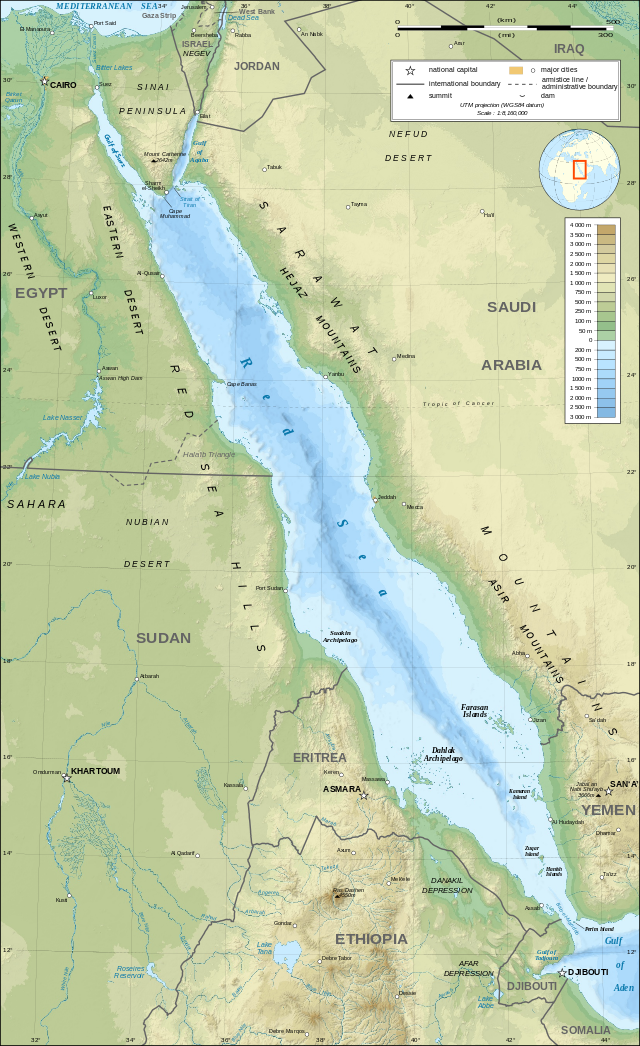
Yemen is strategically important because it sits on the Bab al-Mandab strait, a narrow waterway linking the Red Sea with the Gulf of Aden, through which much of the world's oil shipments pass. Egypt and Saudi Arabia fear a Houthi takeover would threaten free passage through the strait.

Yemen crisis: Who is fighting whom? - BBC News


∼∼∼∼∼∼∼∼∼∼∼∼∼∼∼∼∼∼∼


 Bab al-Mandab has been occupied by homo sapiens for 6-,000 years, whth varying success.

From Wikipedia:

Haines[disambiguation needed] stated that it could become major trading centre and the latter part of the British period proved him correct with Aden growing to become one of the busiest ports in the world. In 1838, under Muhsin bin Fadl, Lahej ceded 194 square kilometres (75 sq mi) including Aden to the British. On 19 January 1839, the British East India Company landed Royal Marines at Aden to secure the territory and stop attacks by pirates against British shipping to India. The port lies about equidistant from the Suez Canal, Mumbai, and Zanzibar, which were all important British possessions. 

The Suez Canal was open in 1869.  The Bab al-Mandab strait has been important to world commerce since then.


Tuesday, April 14, 2015

An open letter to Secretary of State John Kerry, denouncing the Security Council's pandering to the Gulf Corporation Council

Dear Secretary Kerry:

The recent Security Council resolution is a craven pandering to the Gulf Corporation Council in particular and to our own country, in demanding that the Houthis suspend War while permitting other States to continue War, including War upon Civilians, including air and naval bombardments.

The GCC facilitate Ali Abdullah Saleh's departure with some 20 to 60 B (U.N. Security Council Experts estimate) in Yemeni money, which he is now at liberty to use in conducting War against his former, and widely unpopular Vice-President.

The security Council would better

-- require all States and individuals to suspend military action,

-- declare Yemen a Failed State, assume a Mandate for its governance, insure that the remaining oil revenues go to providing for food production in starving Yemen rather than into any private hands,

--recover the money that the GCC allowed Mr. Saleh to steal from the  people of Yemen and return it to the people,

-- allow the South of Yemen to vote on partition,

--  and insure a fair  distribution of  revenues from oil and coffee to all Yemeni.

Only then are fair, representative elections possible.

Yemen is in dire peril.  It is time for the United Nations to stop busying itself with pointless pandering resolutions and rescue all Yemeni from the starvation they face when oil reserves dry up in the next few years.

I urge you to at least support Russia's call on all States and Persons to cease fighting in Yemen.  The GCC comes to the table with unclean hanns.  It should be given no special status, and should be condemned for its past meddling in Yemen's affairs.

Your form for email says a response is due in 3 or so days.  I will print your response.

Sincerely,

Durell Douthit


durell douthit
lawyer emeritus
3423 francis street
Honolulu, Hawaii 96815
808/675-8750
ddouthit@mac.com

შეიძლება თქვენ ფეხით სილამაზე. 


If anyone should come out on top, it should be this valiant South Yemen youngman in Aden, defending his turf against all comers.

Aerial and naval bombardment of Aden


1


STOP IT!  STOP IT!

HAVE YE NO MILK OF HUMAN KINDNESS?

COMMON, KERRY.  DEFY THE GCC.  DO THE RIGHT THING!  NOW!


Thursday, April 9, 2015

The Furies are coming for the Saudi: fate will dole out appropriate punishent

Today, right now,

many Yemeni are starving;
          thousands upon thousands are 
now starving to death

                 for want of a bowl of rice; 

many are wounded; 
       many wounds superate, fester,           feed maggots; 
many a wounded child, many an old man, lie in dire agony; 

many Yemeni mourn the untimely death of men 
whom they loved, who will never more 

         feel the touch of a beloved hand;  

who provided for their families, whose families are now homeless and starving;

the untimely death of women who nurtured their children, cared for their sick, fed and clothed their families, 
         who now go hungry for want of a crust of bread;

the death of children who will never grow old, never 
delight in sexual congress; 
   never know the hand of a lover;  

       in whom those left behind saw support for old age vanish, of children who were their parents' immorality molder away; of children who were valued more than life itself.                                                           

The United States, which seems now so safe and powerful, 
has known the agony of war.  The slaughter in the
    War Between the States 
        has not   been equaled; 
the pain lives on in states such as South Carolina and even in Hawaii.

The extent of the Yemeni pain and loss can  be easily imagined by those of us living on a peaceful Island, protected by the great Pacific Ocean 
  and by every weapon of human             imagination as yet dreamt of

by the use of empathy, a common human faculty.

And those of us who fancy ourselves to be safe must do our best 
to imagine what it is like 
to live and die 
today 
in far-off Yemen:  

we are all related to each Yemeni by no more than six degrees of separation.

Yemeni are our kith and kin.


 So are the Saudi.

So to is the horrible Abdullah Saleh, who make off with five billion dollars stolen from Yemen.  Engineered by America and the Saui.

We all all subject to 

              Fate and Necessity.

I wish you luck.
  
Washington Post

WorldViews
 WorldViews

Forget what you’re hearing. The civil war in Yemen is not a sectarian conflict


An armed member of Houthi militia stands guard at the old city of Sana’a, Yemen, April 6, 2015. (EPA/YAHYA ARHAB)

Saudi Arabia frames its current military intervention into Yemen, which has involved wave upon wave of airstrikes for the past two weeks, as a bid to bring stability to a failing, unraveling state.

The country's impotent Saudi-backed president, Abed Rabbo Mansour Hadi, was forced to flee the southern city of Aden after being cornered by Houthi rebels. The Heaths had seized the capital Sanaa last autumn as a part of a slow-moving takeover of parts of the country. A mess of competing factions, including al-Qaeda, were now warring over whole stretches of Yemen. The Saudi-led campaign, Saudi officials insisted, would turn back the Houthi advance and restore Hadi's "legitimate" government to power.

But another narrative also came immediately into play — that of a Sunni-Shiite proxy war between Saudi interests in Yemen and the Iran-backed Heaths, who belong to a Shiite sect patronized by Tehran's theocratic leadership.

[Read: [Read: How the Yemen conflict risks new chaos in the Middle East]]

Hadi denounced the Houthi as "Iran's puppet" at a March 29 meeting of the Arab League in Egypt where the Saudis enlisted a largely Sunni coalition of the willing to back its Yemen mission. Across the Middle East, factions deemed Iranian proxies vie with groups linked to varying extents with Saudi Arabia, a kingdom whose state Wahabist ideology has found echoes in the fundamentalism of Sunni extremist groups elsewhere.

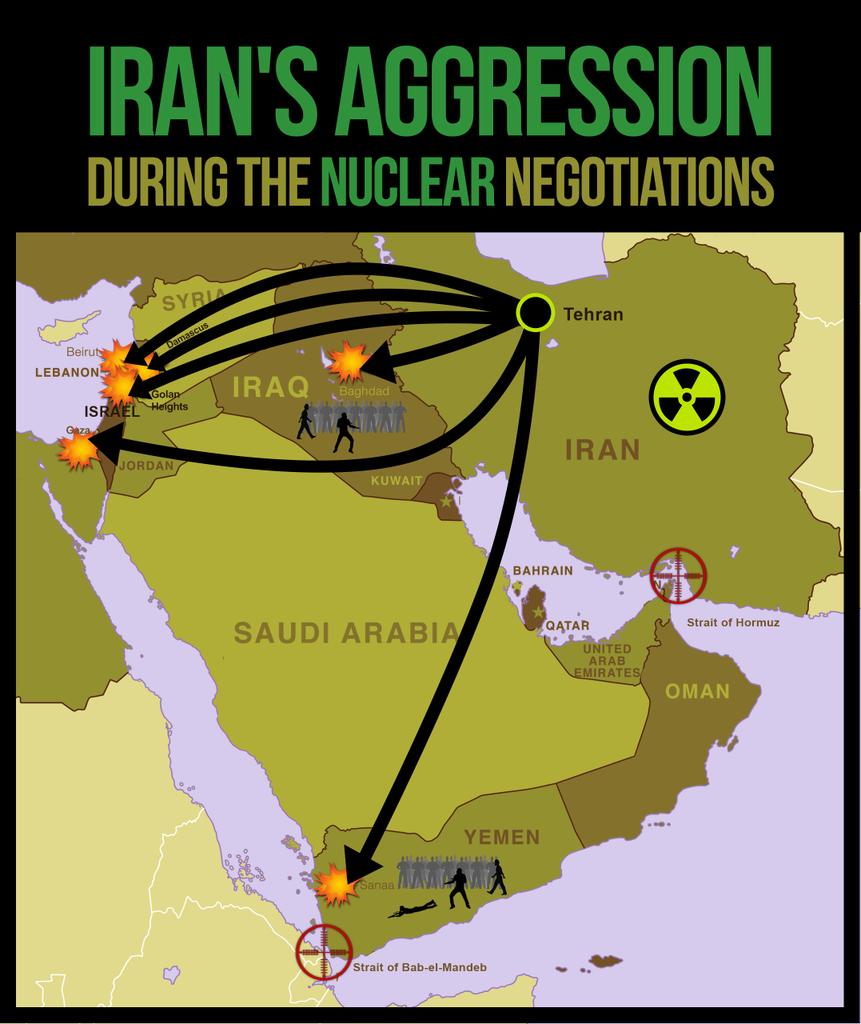
Some argued that this toxic geopolitical mess had infected Yemen. Last week, disquieted by diplomatic negotiations over Iran's nuclear program, Israeli Prime Minister Benjamin Netanyahu pointed to the chaos in Yemen as another sign of Iranian "aggression." He also tweeted this cartoonish guide to Iran's supposed "tentacles of terror."
View image on Twitter

But the political unrest in Yemen is far too complicated to fit into a sectarian binary. First of all, it's wrong to see the Houthis as some sort of direct Iranian proxy -- using the same frame perhaps applied to the Lebanese Shiite organization Hezbollah or Iranian-sponsored militias in Iraq that are now battling the Islamic State.

[See: Yemen's chaos, explained in one chart]

The Houthis, a political-tribal grouping whose heartland is in Yemen's rugged northern highlands, have fought in wars for years without Iranian prompting. In the 1960s, as WorldViews discussed earlier, Houthi militias even cooperated with the Saudis in battles against an Egyptian occupying army.


Yes, many Houthis belong to the Zaydi sect, a branch of Shiism. But Zaydism is rather distinct from the "Twelver" Shiism found in Iran and parts of Iraq — a theological difference that leaves the Zaydis closer to Sunnism, as Col. Pat Lang, a former U.S. defense attache once posted in Yemen, wrote in a piece cited by the Christian Science Monitor.

"For a Zaydi to 'convert' to 12er Shiism is as big and alienating a step as 'conversion' to Sunnism," writes Lang. "Such a change would normally lead to family, clan and tribal ostracism."

Moreover, it's also a matter of debate the extent to which the Houthis, whose current rebellion has roots dating back more than a decade, are operating hand-in-glove with handlers in Tehran.

They still count on considerable Sunni backing within the country and their rise in Yemen is believed to have been enabled by military units loyal to Yemen's ousted President Ali Abdullah Saleh, a strongman who spent decades repressing Houthi political aspirations while ruling in Sanaa.

In this context, Iran is an opportunistic fringe player in what some experts say is really just a continuing tussle for power that began following Saleh's departure in 2011 — and after a flawed political transition forced through by the Saudis and other Sunni Arab monarchies installed Hadi in office.

"There's been a great degree of exaggeration of these ties [with Iran]," said Adam Baron, a Yemen expert with the European Council on Foreign Relations, in an interview with NPR last week. Baron elaborated:

The Houthis are glad to have Iran's political support. They're glad have some financial and military support. But when it comes down to it, it's not as if the Houthis were created by Iran, and further, it's not as if the Houthis are being controlled by Iran. This is a group that is rooted in local Yemeni issues, and its actions are fundamentally rooted in the decisions of its local Yemeni leaders.

The conflict on the ground in Yemen is very much a political one, fueled, as most conflicts are, by competing battles over turf, influence and power. But Saudi Arabia's apparent escalation, which experts say was spurred in part by Riyadh's paranoia about Iranian regional influence, may plunge Yemen even further into crisis.

"Seeing the specter of Iran behind all the challenges that it faces in the Middle East reduces Saudi Arabia’s capacity to make sound strategic assessments of the state of play in the region," writes Nussaibah Younis, of the Washington-based Project on Middle East Democracy.

It's unclear what the Saudi endgame in Yemen is. Their actions so far appear to have only exacerbated tensions in the c0untry. Air strikes have pummeled Yemen's cities, airfields and seaports, but ground forces will be needed to consolidate any real gains in what's already one of the Arab world's most impoverished, yet battle-hardened states.


As my colleague Hugh Naylor reports, the Saudi air campaign has sparked a humanitarian crisis, with food stores and water supplies running low, and the few functioning remnants of the Yemeni government now also seemingly on the verge of collapse.

Apart from a collection of Arab allies, the Saudis are requesting significant military assistance from Pakistan, a Sunni-majority country with deep ties to the kingdom, but also a considerable Shiite minority that's suffered heavily from sectarian violence in recent years. That there's even a possibility of Pakistani troops being deployed on Yemeni soil is a sign of how dangerous a regional conflagration the crisis in Yemen threatens to become.

The implications are stark, warns Fawaz A. Gerges, professor of Middle Eastern politics at the London School of Economics.

"If Yemen descends into all-out war, which is a likely scenario, we could witness a greater humanitarian crisis than that of Syria, in terms of refugees and mass starvation," he told The Washington Post. "You could end up with al-Qaeda being the main winner after this conflict."

That's hardly a scenario welcome to the Saudis, who have spent years trying to neutralize al-Qaeda's Yemeni branch. But it is one partially of their own creation.

Ishaan Tharoor writes about foreign affairs for The Washington Post. He previously was a senior editor at TIME, based first in Hong Kong and later in New York.


⌒⌒⌒⌒⌒⌒⌒⌒⌒⌒⌒〰⎯


Further reading:

The grossly-misleading . . .

Mapping Chaos in Yemen - NYTimes.com


The useful . . .

List of wars involving Saudi Arabia - Wikipedia, the free encyclopedia


Establishing an Islamic state is not only a political goal of the Saudi and other Sunni peoples.

A quotation from
Stranger Still

Kamel Daoud and Algeria, caught between Islamist fervor and cultural flowering.
By ADAM SHATZAPRIL 1, 2015:
 A brilliant book review from the New York Times.  From that review:
He introduced  [Kamel Daoud] to the writings of Abul Ala Mawdudi, Sayyid Qutb and Hassan al-Banna — the founders of modern Sunni Islamism — and persuaded him that the individual salvation he sought could be achieved only through collective salvation, in the form of an Islamic state.  [Emphasis added]

If you have ever had a strong faith in a religion . . .

if your faith was so strong that you would kill for it . . .

if you have hurt others grievously in the secure belief that an Islamic state would be your salvation,

then, as you watch your Islamic State crumble bit by bit, doubt, fear, trembling, the sickness unto death is your lot,

and the lot  of the fearful Saudi, now bombing the wretched peoples of Yemen 

out of fear, 

who originated the Sunni War out of fear and cowardliness on the Unbelieving World. . .  .

. . ..if you joined the Islamic State, and the future of your immortal soul
rested on the success of that venture . . .

as you watched Tikrit fall to the Unbelievers, and then Mosul and all of Iraq fall,
and then your last holdout in Syria fall to Unbelievers,

how great your despair!

 how fierce and brutal your defiance in the face of defeat! . . .


 how terrible the future must then seem to you at that time.      

My heart breaks as I contemplate your well-deserved
final
failure.

[Søren Kierkegaard, Fear and Trembling; The Sickness Unto Death]

You, valiant Salafi warrior, should have followed . . .

Tao Te Ching (Dao De Jing)
Classic of the Way and Virtue

道德經

By Lao Tzu (Laozi)

Chapter 31
Tao Te Ching (Dao De Jing) by Lao Tzu
Create Don't Destroy, Avoid Weapons, Stop Wars, Delight Not in Warfare, Be Peaceful, Avoid Wars,  偃武  

"Now arms, however beautiful, are instruments of evil omen, hateful, it may be said, to all creatures. 

Therefore they who have the Tao do not like to employ them.

The superior man ordinarily considers the left hand the most honorable place, but in time of war the right hand.
 
Those sharp weapons are instruments of evil omen, and not the instruments of the superior man.

He uses them only on the compulsion of necessity.
 
Calm and repose are what he prizes; victory by force of arms is to him undesirable. 

To consider this desirable would be to delight in the slaughter of men.

He who delights in the slaughter of men cannot get his will in the kingdom.
On occasions of festivity to be on the left hand is the prized position; on occasions of mourning, the right hand. 

The second in command of the army has his place on the left.

The general commanding in chief has his on the right; his place, that is, is assigned to him as in the rites of mourning. 
 
He who has killed multitudes of men should weep for them with the bitterest grief.

The the victor in battle has his place according to those rites."

-   Translated by James Legge, 1891, Chapter 31 

My president, whom I admire above all living men except my brother, I wish the bitterest grief, and I, being a part of the U.S. sovereign, share in that grief.

Hope John Kerry does, too.