Showing posts with label starvation. Show all posts

Sunday, November 8, 2015

A way to avoid a worldwide bloody revolution

There but for the grace of God, go I.

Allegedly from a mid-sixteenth-century 
statement by John Bradford
"There but for the grace of God, goes John Bradford",
 in reference to a group of prisoners 
being led to execution.
From Wikipedia.

Tom Stoddart. Sudan. 1998  
Highly recommended


There because of the  malicious cruelty 
of  Omnipotent, Nonexistent god, 
goes this young man.


There because of the merciless indifference of 
the Universe, 
goes this young man


There is plenty of food in the world 
to feed all. 
 There because of the selfishness of the masters of the world's food distribution systems and the deliberate cruelty of men who murder
those who try to feed the starving . . .
 (Tens of thousands of civilians have been killed, the country's economy destroyed and several regions pushed to the brink of famine.  Khaleej Times)

goes this young man.


Because of the 
unconscionable failure 
of the world's richest men 
gathering annually at the World Economic Forum in the remote safety of Davos, Switzerland . . .

to heed the demands 
of the many who urge a more equitable distribution of wealth . . . 

 (and see New Oxfam report says half of global wealth held by the 1%)

billions of us live with hunger, pain, death.


Each one of the suffering billions 
 is kin to each one of us, 
separated by no more than 
six degrees of separation.


Bill Gates, the world's richest man, . . .

 in an address to the Harvard faculty and students:
 I remember going to Davos some years back and sitting on a global health panel that was discussing ways to save millions of lives. Millions! Think of the thrill of saving just one person's life – then multiply that by millions. … Yet this was the most boring panel I've ever been on – ever. So boring even I couldn't bear it. . . .  
Members of the Harvard Family: Here in the Yard is one of the great collections of intellectual talent in the world. 
What for? There is no question that the faculty, the alumni, the students, and the benefactors of Harvard have used their power to improve the lives of people here and around the world. But can we do more? Can Harvard dedicate its intellect to improving the lives of people who will never even hear its name? Let me make a request of the deans and the professors – the intellectual leaders here at Harvard: As you hire new faculty, award tenure, review curriculum, and determine degree requirements, please ask yourselves: Should our best minds be dedicated to solving our biggest problems? Should Harvard encourage its faculty to take on the world's worst inequities? Should Harvard students learn about the depth of global poverty … the prevalence of world hunger … the scarcity of clean water …the girls kept out of school … the children who die from diseases we can cure? Should the world's most privileged people learn about the lives of the world's least privileged? These are not rhetorical questions – you will answer with your policiesMy mother, who was filled with pride the day I was admitted here – never stopped pressing me to do more for others. A few days before my wedding, she hosted a bridal event, at which she read aloud a letter about marriage that she had written to Melinda. My mother was very ill with cancer at the time, but she saw one more opportunity to deliver her message, and at the close of the letter she said: "From those to whom much is given, much is expected." When you consider what those of us here in this Yard have been given – in talent, privilege, and opportunity – there is almost no limit to what the world has a right to expect from us. In line with the promise of this age, I want to exhort each of the graduates here to take on an issue – a complex problem, a deep inequity, and become a specialist on it. If you make it the focus of your career, that would be phenomenal. But you don't have to do that to make an impact. For a few hours every week, you can use the growing power of the Internet to get informed, find others with the same interests, see the barriers, and find ways to cut through them. Don't let complexity stop you. Be activists. Take on the big inequities. It will be one of the great experiences of your lives.You graduates are coming of age in an amazing time. As you leave Harvard, you have technology that members of my class never had. You have awareness of global inequity, which we did not have. And with that awareness, you likely also have an informed conscience that will torment you if you abandon these people whose lives you could change with very little effort.You have more than we had; you must start sooner, and carry on longer. Knowing what you know, how could you not? And I hope you will come back here to Harvard 30 years from now and reflect on what you have done with your talent and your energy. I hope you will judge yourselves not on your professional accomplishments alone, but also on how well you have addressed the world's deepest inequities … on how well you treated people a world away who have nothing in common with you but their humanity. 

This is the result of the present failure of the folks at Davos 
to heed Gates' wise words:


——————————

The overdevelopment of condos for the very rich on my home Island in the middle of thePacific Ocean has driven housing prices absurdly high.  

I have failed over time to do more to halt excessive development on Oahu. 

Many to whom Hawaii has been home for untold generations, where the bones of the Ancestors are buried, now go homeless in their own homeland.

Many of the homeless men and women are bright, capable persons who work at the best jobs available to them, and they cannot afford a place to live.  Many are depressed, suicidal, enraged, desperate; many are determined to retake their homeland.
  
There, because of my inattention and failure to work with more vigor to stop excessive development, go these:



Timor mortis, conturbat me.

The fear of death may confound you, too, as you approach the time to 
 "enter again the round Zion of the water bead  /And the synagogue of the ear of corn".
Dylan Thomas, Refusal to Mourn 

Especially confounding may be knowing that you could have done more to ease the suffering of  kith and kin.  It is so for me.

Do what is in your power to do to end wealth inequality.  Do it for your own sake.  Do it for those you love.

Wealth is now more unevenly distributed than it was before the bloody French Revolution, which saw the wealthiest beheaded.  

Help to change the was wealth is distributed,
 to avoid the gathering storm of bloody revolution.

Or become the 
Worldwide Revolution.

The alternative -- a static, unchanging, brutal worldwide bureaucracy serving the uncaring few, is not to be tolerated.

Thanks!


Thursday, April 9, 2015

The Furies are coming for the Saudi: fate will dole out appropriate punishent

Today, right now,

many Yemeni are starving;
          thousands upon thousands are 
now starving to death

                 for want of a bowl of rice; 

many are wounded; 
       many wounds superate, fester,           feed maggots; 
many a wounded child, many an old man, lie in dire agony; 

many Yemeni mourn the untimely death of men 
whom they loved, who will never more 

         feel the touch of a beloved hand;  

who provided for their families, whose families are now homeless and starving;

the untimely death of women who nurtured their children, cared for their sick, fed and clothed their families, 
         who now go hungry for want of a crust of bread;

the death of children who will never grow old, never 
delight in sexual congress; 
   never know the hand of a lover;  

       in whom those left behind saw support for old age vanish, of children who were their parents' immorality molder away; of children who were valued more than life itself.                                                           

The United States, which seems now so safe and powerful, 
has known the agony of war.  The slaughter in the
    War Between the States 
        has not   been equaled; 
the pain lives on in states such as South Carolina and even in Hawaii.

The extent of the Yemeni pain and loss can  be easily imagined by those of us living on a peaceful Island, protected by the great Pacific Ocean 
  and by every weapon of human             imagination as yet dreamt of

by the use of empathy, a common human faculty.

And those of us who fancy ourselves to be safe must do our best 
to imagine what it is like 
to live and die 
today 
in far-off Yemen:  

we are all related to each Yemeni by no more than six degrees of separation.

Yemeni are our kith and kin.


 So are the Saudi.

So to is the horrible Abdullah Saleh, who make off with five billion dollars stolen from Yemen.  Engineered by America and the Saui.

We all all subject to 

              Fate and Necessity.

I wish you luck.
  
Washington Post

WorldViews
 WorldViews

Forget what you’re hearing. The civil war in Yemen is not a sectarian conflict


An armed member of Houthi militia stands guard at the old city of Sana’a, Yemen, April 6, 2015. (EPA/YAHYA ARHAB)

Saudi Arabia frames its current military intervention into Yemen, which has involved wave upon wave of airstrikes for the past two weeks, as a bid to bring stability to a failing, unraveling state.

The country's impotent Saudi-backed president, Abed Rabbo Mansour Hadi, was forced to flee the southern city of Aden after being cornered by Houthi rebels. The Heaths had seized the capital Sanaa last autumn as a part of a slow-moving takeover of parts of the country. A mess of competing factions, including al-Qaeda, were now warring over whole stretches of Yemen. The Saudi-led campaign, Saudi officials insisted, would turn back the Houthi advance and restore Hadi's "legitimate" government to power.

But another narrative also came immediately into play — that of a Sunni-Shiite proxy war between Saudi interests in Yemen and the Iran-backed Heaths, who belong to a Shiite sect patronized by Tehran's theocratic leadership.

[Read: [Read: How the Yemen conflict risks new chaos in the Middle East]]

Hadi denounced the Houthi as "Iran's puppet" at a March 29 meeting of the Arab League in Egypt where the Saudis enlisted a largely Sunni coalition of the willing to back its Yemen mission. Across the Middle East, factions deemed Iranian proxies vie with groups linked to varying extents with Saudi Arabia, a kingdom whose state Wahabist ideology has found echoes in the fundamentalism of Sunni extremist groups elsewhere.

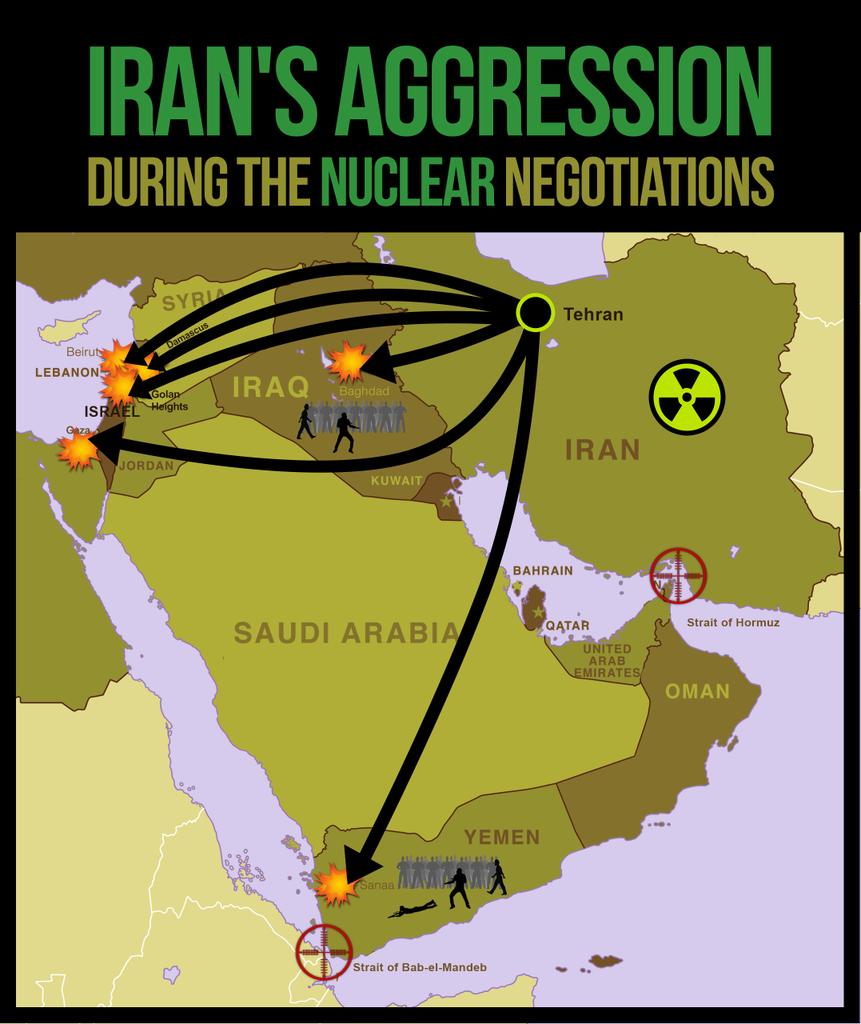
Some argued that this toxic geopolitical mess had infected Yemen. Last week, disquieted by diplomatic negotiations over Iran's nuclear program, Israeli Prime Minister Benjamin Netanyahu pointed to the chaos in Yemen as another sign of Iranian "aggression." He also tweeted this cartoonish guide to Iran's supposed "tentacles of terror."
View image on Twitter

But the political unrest in Yemen is far too complicated to fit into a sectarian binary. First of all, it's wrong to see the Houthis as some sort of direct Iranian proxy -- using the same frame perhaps applied to the Lebanese Shiite organization Hezbollah or Iranian-sponsored militias in Iraq that are now battling the Islamic State.

[See: Yemen's chaos, explained in one chart]

The Houthis, a political-tribal grouping whose heartland is in Yemen's rugged northern highlands, have fought in wars for years without Iranian prompting. In the 1960s, as WorldViews discussed earlier, Houthi militias even cooperated with the Saudis in battles against an Egyptian occupying army.


Yes, many Houthis belong to the Zaydi sect, a branch of Shiism. But Zaydism is rather distinct from the "Twelver" Shiism found in Iran and parts of Iraq — a theological difference that leaves the Zaydis closer to Sunnism, as Col. Pat Lang, a former U.S. defense attache once posted in Yemen, wrote in a piece cited by the Christian Science Monitor.

"For a Zaydi to 'convert' to 12er Shiism is as big and alienating a step as 'conversion' to Sunnism," writes Lang. "Such a change would normally lead to family, clan and tribal ostracism."

Moreover, it's also a matter of debate the extent to which the Houthis, whose current rebellion has roots dating back more than a decade, are operating hand-in-glove with handlers in Tehran.

They still count on considerable Sunni backing within the country and their rise in Yemen is believed to have been enabled by military units loyal to Yemen's ousted President Ali Abdullah Saleh, a strongman who spent decades repressing Houthi political aspirations while ruling in Sanaa.

In this context, Iran is an opportunistic fringe player in what some experts say is really just a continuing tussle for power that began following Saleh's departure in 2011 — and after a flawed political transition forced through by the Saudis and other Sunni Arab monarchies installed Hadi in office.

"There's been a great degree of exaggeration of these ties [with Iran]," said Adam Baron, a Yemen expert with the European Council on Foreign Relations, in an interview with NPR last week. Baron elaborated:

The Houthis are glad to have Iran's political support. They're glad have some financial and military support. But when it comes down to it, it's not as if the Houthis were created by Iran, and further, it's not as if the Houthis are being controlled by Iran. This is a group that is rooted in local Yemeni issues, and its actions are fundamentally rooted in the decisions of its local Yemeni leaders.

The conflict on the ground in Yemen is very much a political one, fueled, as most conflicts are, by competing battles over turf, influence and power. But Saudi Arabia's apparent escalation, which experts say was spurred in part by Riyadh's paranoia about Iranian regional influence, may plunge Yemen even further into crisis.

"Seeing the specter of Iran behind all the challenges that it faces in the Middle East reduces Saudi Arabia’s capacity to make sound strategic assessments of the state of play in the region," writes Nussaibah Younis, of the Washington-based Project on Middle East Democracy.

It's unclear what the Saudi endgame in Yemen is. Their actions so far appear to have only exacerbated tensions in the c0untry. Air strikes have pummeled Yemen's cities, airfields and seaports, but ground forces will be needed to consolidate any real gains in what's already one of the Arab world's most impoverished, yet battle-hardened states.


As my colleague Hugh Naylor reports, the Saudi air campaign has sparked a humanitarian crisis, with food stores and water supplies running low, and the few functioning remnants of the Yemeni government now also seemingly on the verge of collapse.

Apart from a collection of Arab allies, the Saudis are requesting significant military assistance from Pakistan, a Sunni-majority country with deep ties to the kingdom, but also a considerable Shiite minority that's suffered heavily from sectarian violence in recent years. That there's even a possibility of Pakistani troops being deployed on Yemeni soil is a sign of how dangerous a regional conflagration the crisis in Yemen threatens to become.

The implications are stark, warns Fawaz A. Gerges, professor of Middle Eastern politics at the London School of Economics.

"If Yemen descends into all-out war, which is a likely scenario, we could witness a greater humanitarian crisis than that of Syria, in terms of refugees and mass starvation," he told The Washington Post. "You could end up with al-Qaeda being the main winner after this conflict."

That's hardly a scenario welcome to the Saudis, who have spent years trying to neutralize al-Qaeda's Yemeni branch. But it is one partially of their own creation.

Ishaan Tharoor writes about foreign affairs for The Washington Post. He previously was a senior editor at TIME, based first in Hong Kong and later in New York.


⌒⌒⌒⌒⌒⌒⌒⌒⌒⌒⌒〰⎯


Further reading:

The grossly-misleading . . .

Mapping Chaos in Yemen - NYTimes.com


The useful . . .

List of wars involving Saudi Arabia - Wikipedia, the free encyclopedia


Establishing an Islamic state is not only a political goal of the Saudi and other Sunni peoples.

A quotation from
Stranger Still

Kamel Daoud and Algeria, caught between Islamist fervor and cultural flowering.
By ADAM SHATZAPRIL 1, 2015:
 A brilliant book review from the New York Times.  From that review:
He introduced  [Kamel Daoud] to the writings of Abul Ala Mawdudi, Sayyid Qutb and Hassan al-Banna — the founders of modern Sunni Islamism — and persuaded him that the individual salvation he sought could be achieved only through collective salvation, in the form of an Islamic state.  [Emphasis added]

If you have ever had a strong faith in a religion . . .

if your faith was so strong that you would kill for it . . .

if you have hurt others grievously in the secure belief that an Islamic state would be your salvation,

then, as you watch your Islamic State crumble bit by bit, doubt, fear, trembling, the sickness unto death is your lot,

and the lot  of the fearful Saudi, now bombing the wretched peoples of Yemen 

out of fear, 

who originated the Sunni War out of fear and cowardliness on the Unbelieving World. . .  .

. . ..if you joined the Islamic State, and the future of your immortal soul
rested on the success of that venture . . .

as you watched Tikrit fall to the Unbelievers, and then Mosul and all of Iraq fall,
and then your last holdout in Syria fall to Unbelievers,

how great your despair!

 how fierce and brutal your defiance in the face of defeat! . . .


 how terrible the future must then seem to you at that time.      

My heart breaks as I contemplate your well-deserved
final
failure.

[Søren Kierkegaard, Fear and Trembling; The Sickness Unto Death]

You, valiant Salafi warrior, should have followed . . .

Tao Te Ching (Dao De Jing)
Classic of the Way and Virtue

道德經

By Lao Tzu (Laozi)

Chapter 31
Tao Te Ching (Dao De Jing) by Lao Tzu
Create Don't Destroy, Avoid Weapons, Stop Wars, Delight Not in Warfare, Be Peaceful, Avoid Wars,  偃武  

"Now arms, however beautiful, are instruments of evil omen, hateful, it may be said, to all creatures. 

Therefore they who have the Tao do not like to employ them.

The superior man ordinarily considers the left hand the most honorable place, but in time of war the right hand.
 
Those sharp weapons are instruments of evil omen, and not the instruments of the superior man.

He uses them only on the compulsion of necessity.
 
Calm and repose are what he prizes; victory by force of arms is to him undesirable. 

To consider this desirable would be to delight in the slaughter of men.

He who delights in the slaughter of men cannot get his will in the kingdom.
On occasions of festivity to be on the left hand is the prized position; on occasions of mourning, the right hand. 

The second in command of the army has his place on the left.

The general commanding in chief has his on the right; his place, that is, is assigned to him as in the rites of mourning. 
 
He who has killed multitudes of men should weep for them with the bitterest grief.

The the victor in battle has his place according to those rites."

-   Translated by James Legge, 1891, Chapter 31 

My president, whom I admire above all living men except my brother, I wish the bitterest grief, and I, being a part of the U.S. sovereign, share in that grief.

Hope John Kerry does, too.

Friday, November 18, 2011

Images of the World as it seems to be

These are images I captured from the Web over a 10-year period, while I was recovering from a stroke. I did not and could not, then, record the blog from whence the images came.  If I've got one of yours, I'd love to give you credit for it; and if you insist, I'll remove it with greatest reluctance.  I love each of these images.


I like all the marines I know.
I fear I'm caught in that 'ol
"Hate the Sin, Love the Sinner"
nonsense.


Shakespeare, Titus Andronicus, sorta.

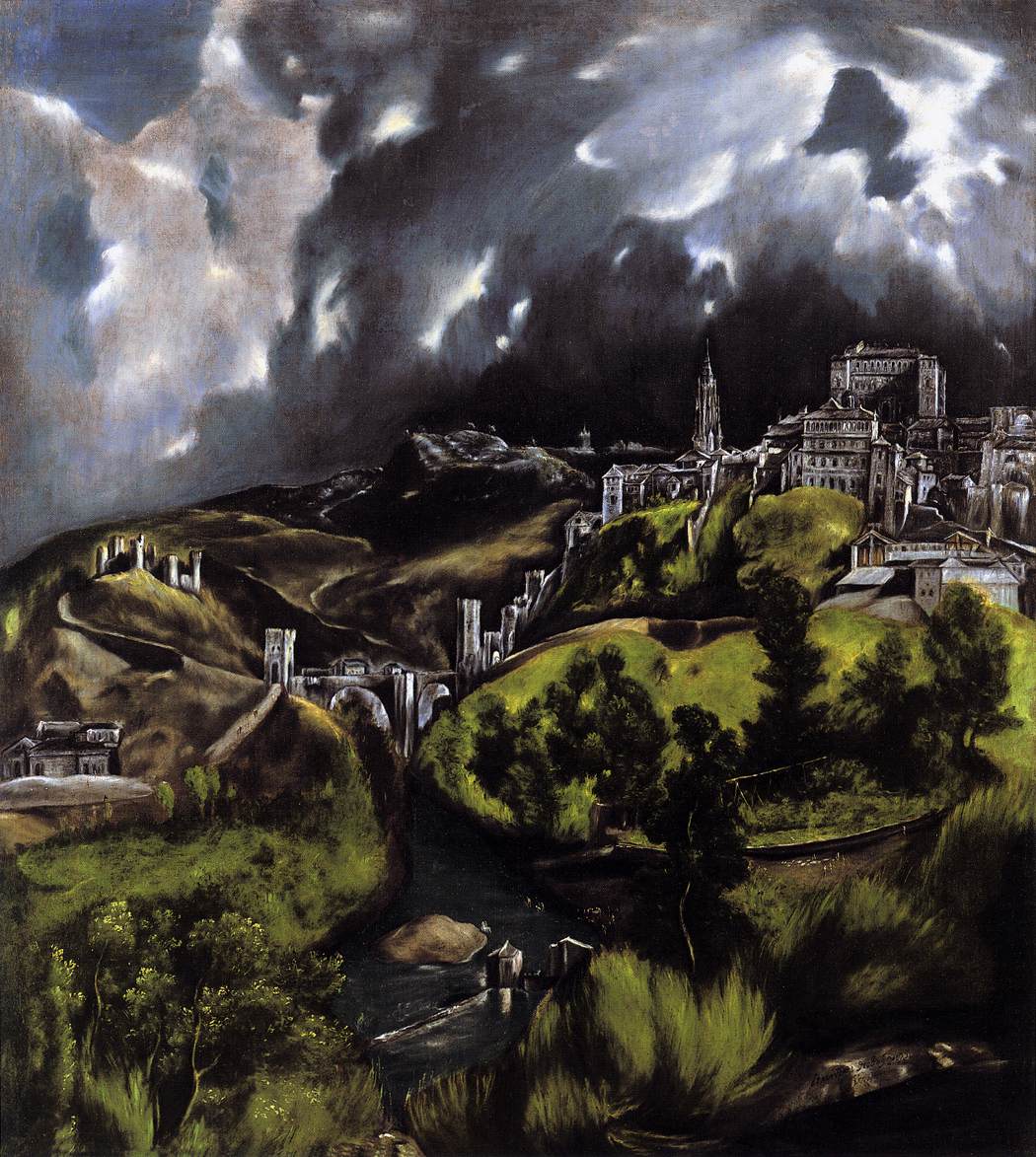
Peace, after a storm.
We have always known
the beauty and horror of 
Violence.
A View of Toledo, El Greco, lib art


The Kurdish Peshmerga
the greatest fighting force,
 man for man,
outside Pahstunistan.


Another kind of grace.
Clyde Archer, a  Nee York dancer in Madrid, from a  
Spanish blog I'll keep, possibly named Magazine


This is on the side of a nine-story
building in Tehran. Lotta folks
didn't like our bombing
Iraq.

This design could well serve as
our own, only substitute
drones for
skulls.

And of course change the slogan.
Photo by Mike Meany


Brazilians protest Bushco's War -- you know, the one that bankrupted us.


Two kinds of innocence


Photographed by Kevin Caarter.  See All Men are Brothers.


Entitled Worst Slum in America.
I kinda like it.
"You would," some will say.


This, one of my favorites, is said to belong
to Bhavesh Moody, Man vs.Man.
A truly great work.
Congratulations, Mr. Moody.


Note the boy in the window.


Not only is the human spirit indomitable,
football (soccer to you North Americans)
is too.
Polaris Images says this about this image:
"Adam Nadel has won 1st prize Sports Features Singles 
in the 2004 World Press Contest
 for a photograph of the 
Amputee Soccer team of Sierra Leone"


You try to find a shirtless construction worker 
who isn't a professional model.  Hard to do.
Construction workers
are modest guys.


The URL is "cuba-christ1".  Can't find it.
I reckon that Our Lord and Savior
is about 12, now.

When He comes into His own,
the Tenth Imam, revered by Shiites,
will exit Occlusion, and History
will end.

No wonder there are Disturbances in the Firmament.


If we lived in Uruguay, the cow might sport a map
like this:


Rio Ganges, a Spanish language
blog has it.


The most sophisticated woman
in the whole world. . .
image1730859, but I bet you can't find it.  Pulled, I think it has been. 
Obscene, I guess it is thought to be.
Disrespectful?
Human?
No!
The Queen's grandson.


. . . and then the rest of the world.


My friend M., or might as well be,
after he Battle of Fallujah . . .
M. can imitate the sound
each caliber of bullet makes
as it speeds past
his ear.
To this day.
Probably as long ass he lives.
URL is "iraq.loarge".  I can find it.
If you can, let me know.
One of the great pics of last century.


I like it also because I
remember being
with Abe on
 this spot.


Irony, irony, irony.
Might as well love it.
Can't escape it, no how.


Us . . .

. . . and our bitterest enemies.
Take your lick.


St. Louis, where we want to move.


You, soon enough.


India. . . .


My clients, as it might have been.


All I remember is that
the guy is one of the
world's great
football
players.


The blog advises us to
quit complaining
about your
job.

Some other good pics, too.


Womanless Saudi men
trying to have fun.

Sorry lot, the lot of  'em.


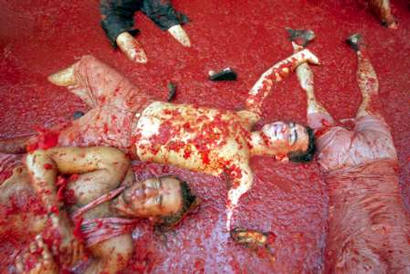
La Tomatilla, in Buñol, Spain.  I'll get there, some day.

Leroy Williams, next farm over, had trailers
 full of ripe tomatoes.  We used to chunk 'em 
at each other.  Great fun.  
This looks better.


Our guy.


Our ancestors saw the Sun as Helios, the Sun God, said to ride a chariot or fire across the Heavens each day.  Her, Nicholas Poussin, the great Baroque painter, shows Helios with his son Phaeton, Saturn, and the Four Seasons, personified.  Phaeton "borrowed" his dad's chariot and crashed it into the Earth, setting it on fire.  Oops.


Ain't no sunshine when she's gone
It's not warm when she's away
Ain't no sunshine when she's gone
She always gone too long anytime she goes away

Bill Withers


And this, boys and girls, is the whole shebang.


This is a picture of the light, at 3.7 degrees Kelvin,
from the Big Bang
which began streaming in all directions 
about 100,000 years after the Universe cooled
enough so that 
light
could escape the cloud of 
other particles.
This light has been streaming throughout the
Universe for  perhaps 13.75 billion
years.

Note the light is slightly uneven:  if it were uniform , we wouldn't be.


We have 7 billion people on earth,
nearly enough for one billion for each billion years
since the Big Bang.
.
The 7 billion folks have 5 billion cel phones.
Our friend Josh
who quite sensibly makes cel phones for a living
 estimates that
1.47 billion of the cel phones
can access google images, after government censorship.

Suppose half that number are school or madrassa children,
 and each child shares
his favorite images 
with three friends


For years I agreed with Yates:

 Things fall apart; the centre cannot hold;
    Mere anarchy is loosed upon the world,
    The blood-dimmed tide is loosed, and everywhere
    The ceremony of innocence is drowned;
    The best lack all conviction, while the worst
    Are full of passionate intensity.


If you look at Congress now, you'll agree with Yates.  

If you look at the World through my eyes,

 the closer I move to death,
says my old friend Dylan Thomas,

  one man through his sundered hulks,
  The louder the sun blooms
And the tusked, ramshackling sea exults;
  And every wave of the way
And gale I tackle, the whole world then,
  With more triumphant faith
That ever was since the world was said,
  Spins its morning of praise,

  I hear the bouncing hills
Grow larked and greener at berry brown
  Fall and the dew larks sing
Taller this thunderclap spring, and how
  More spanned with angles ride
The mansouled fiery islands! Oh,
  Holier then their eyes,
And my shining men no more alone
  As I sail out to die.


What a world is aborning!

How I love its awful beauty!