Showing posts with label Iran. Show all posts

Friday, October 7, 2016


The Times article lists some of Russia's national interests at stake in Syria:

Moscow considers Mr. Assad’s survival crucial to protecting its interests in Syria, which include combating jihadism, preserving intelligence and military assets, and asserting that Russia is a geopolitical player in the Middle East.

Russia, with Salafi Jihadists fighting in Dagestan and up the Volga River into the heart of Russia naturally wants to defeat Saudi Arabia's Salafi Jihadists in Syria. It also wants to protect its naval base in Syria, it's only direct outlet to the Mediterranean Sea.   These are rational national interests.

The article does not mention Iran's and Qatar's mutual and conflicting interests in a pipeline through Syria without which neither can deliver natural gas from the Pfs Natural Gas field, from which each nation could deliver huge amounts of gas to Europe.   

Russia's interest is to prevent Qatar from delivering Pars gas to Europe, undercutting the price of the oil it delivers to Europe, with disastrous effect on the Russian economy.  Russia is less concerned with Iran's delivering gas to Europe, believing it can cut a deal with Iran to protect its price monopoly.  Both Iran and Qatar have proposed gas lines through Syria.  See here.


Russia has vital national interests in Syria.

The United State's only national interest is protecting the Gulf Cooperation Council's oil monopoly from competition from Iran, an interest that has long outlasted its usefulness.

 Aleppo is full of heart-rending tragedy.  Yemen is worse.  The United States can do something about Yemen; doing something about Aleppo will require great diplomatic skill.  Bombast won't cut it. 

 The Times article, below, is rational.  One hopes that our next president, whatever the campaign rhetoric, will recognize it.  I believe Mrs. Clinton does.  Friends fear she is more war-like.


The Opinion Pages | OP-ED 
Don’t Intervene in Syria
By STEVEN SIMON and JONATHAN STEVENSON OCT. 6, 2016
 Credit Anthony Russo
The cease-fire in Syria that the United States and Russia tortuously negotiated has, like the one before it, fallen apart.

The trouble began when an errant American airstrike killed some 60 Syrian government soldiers. Then, Russia resumed its disingenuous grandstanding and the Syrian government, with Russia’s support, went back to indiscriminately bombing rebel-held areas of Aleppo. On Monday, less than a month after the agreement went into effect, Secretary of State John Kerry announced that the United States would break off talks with Russia on trying to revive it.

This failure, accompanied by images of suffering in Aleppo, has inspired renewed calls for a tougher American policy in Syria from liberal hawks and traditional conservatives alike. At the vice-presidential debate on Tuesday, both the Democrat, Senator Tim Kaine of Virginia, and the Republican, Gov. Mike Pence of Indiana, advocated more aggressive American action.

But the truth is that it is too late for the United States to wade deeper into the Syrian conflict without risking a major war, or, at best, looking feckless by failing to fully commit to confronting Russia and President Bashar al-Assad of Syria and then backing down. The goal now should be reducing harm, saving lives and keeping prospects for a political deal alive. Cease-fire talks between the United States and Russia, tormented though they may be, remain the best way to achieve this.

Although Russia has denied it, it is clear that Moscow considers Mr. Assad’s survival crucial to protecting its interests in Syria, which include combating jihadism, preserving intelligence and military assets, and asserting that Russia is a geopolitical player in the Middle East. Russia has unflinchingly protected the Assad government both militarily and at the United Nations Security Council.

Indeed, Mr. Assad seems to enjoy practically unlimited leverage over Russia. Despite narrowly escaping American punishment for using chemical weapons by surrendering his stockpile of deadly nerve gas and other poisons in 2013, Mr. Assad has felt free to continue using toxic commercial chlorine gas. Even though Russia moved toward political compromise when it provisionally withdrew from Syria in March, Mr. Assad was not inclined to give peace talks a serious chance. In both cases, Russia fell back in line with Mr. Assad’s defiant brutality.

There are probably limits to Moscow’s deference to Mr. Assad’s blood lust, but it is unclear what they are. This is what makes an American escalation in Syria so dangerous.

American supporters of intervention, including the vice-presidential candidates, often say that the United States should create a no-fly zone in Syria to protect civilians from Mr. Assad and Russia’s bombs. But imagine how this might work: An American warplane enforcing a no-fly zone would risk fire from a Russian-made antiaircraft battery or fighter. (Just this week Russia shipped new antiaircraft systems to Syria.)

This risk clearly worries advocates for the use of force within the Obama administration. They are said to favor increased air support for the Syrian rebels that would avoid direct confrontation with the Russians. But small-scale, targeted bombing is unlikely to change Syrian behavior, so to be effective the strikes would have to escalate. (Alternatively, ineffective strikes could be ended, but this would make the United States look incompetent.) This would ultimately lead to a violent response, which would compel the United States to retaliate against Russian and Syrian government ground targets.

As conflict spiraled and casualties increased, so would international pressure for another costly, protracted and thankless American-led ground intervention to enforce peace, which domestic opinion in the United States would not support. While Russia’s real appetite for a political solution in the Syria conflict is unclear, it is wiser to test unknown political limits than unknown military ones.

Some of those advocating more intervention in Syria believe that as the so-called indispensable power, the United States has an ethical responsibility to reduce the suffering caused by Syrian and Russian bombing of civilians. Another camp of interventionists criticizes what it sees as President Obama’s weakness, heartlessness and strategic myopia, and wants the United States to stand up to Russia and assert its intention to remain a major geopolitical player in the region.

The liberal interventionists seem to have forgotten that it is no longer the 1990s. Disastrous forays in Iraq and Libya have undermined any American willingness to put values before interests. Meanwhile, the second group of interventionists seem to have forgotten that Syria has been Moscow’s client since early in the Cold War — a situation Washington was willing to live with when the geostrategic stakes were much higher.
The United States does, in fact, have a clear Syria policy: Roll back the Islamic State by way of the air campaign and American-supported Syrian rebel forces, coordinating with Russia to the extent possible; provide extensive humanitarian support; and continue to press for a sustainable cease-fire and a negotiated political transition involving Mr. Assad’s eventual departure. It may be frustrating, but against the alternatives, it is the only sensible course of action.

Certainly, the Syrian government and Russia have manipulated the cease-fires, using them as cover for continuing offensives. Nonetheless, fragile though they have been, these deals ratchet down the overall level of violence and save lives.

The deal struck by Mr. Kerry and his Russian counterpart, Sergey V. Lavrov, for the United States and Russia to coordinate counter-jihadist operations and restrain opposition and government military activity was intended to produce a durable cease-fire, promote more effective humanitarian operations and re-energize political talks. Although it has fallen apart, the next step, unsatisfying as it may be, is to try again.

Steven Simon, a professor at Amherst College, was the National Security Council’s senior director for the Middle East and North Africa from 2011 through 2012. Jonathan Stevenson, a senior fellow at the International Institute for Strategic Studies and a fellow at Cullman Center, was the council’s director for political-military affairs for the Middle East and North Africa from 2011 to 2013

Sunday, February 21, 2016

Iran not to blame for Yemen


Western new outlets assert that Yemen is a proxy war for Iran's struggle against Saudi Arabia.  That is a position the Saudi have assiduously promoted as a justification fora its genocide in Yemen.  See Time, The Arabian country has become the scene of the Middle East's second proxy warDWPower struggle between Saudi Arabia and Iran hampers peace process; the egregious Saudi propaganda piece in Arab NewsIranian cruelty against Yemen civilians rapped.

Not so, according to ForeignAffairs Magazine, a a scholarly, careful, and generally neoconic publication that one would expect to support the Saudi.  A perceptive, historically accurate account of Yemen.


From foreignPolicy Magazine:
SNAPSHOT April 19, 2015  

Iran's Game in Yemen

Why Tehran Isn't to Blame for the Civil War
By Mohsen Milani

In the past four years, Saudi Arabia has used its military to intervene in both Bahrain and Yemen. Its rationale in both cases: To protect those Arab countries from “Persian subversion.” In its discussions of foreign policy, Riyadh portrays Iran as a hegemonic power whose nefarious support of its Shia Houthi proxy precipitated a civil war in Yemen—a struggle the Saudi Ambassador to the United States, Adel bin Ahmed Al-Jubeir, describes as being “between good and evil.”  

But Saudi Arabia is grossly exaggerating Iran’s power in Yemen to justify its own expansionist ambitions. Iran is not the cause of the civil war, nor are the Houthis its proxy. Chaos, not Iran, controls Yemen. With no vital economic or strategic interests in Yemen, Iran has, for the last few years, only opportunistically supported the Houthis to create a political sphere of influence. It did so through soft power and with minimal investment because the Houthis have been more interested in Iran than Iran has been in them. Of course, Iran, like the international community, is deeply concerned about the security of the Bab el-Mandeb strait in Yemen through which millions of dollars worth of oil flows, but it will not get militarily engaged in the lingering civil war, since Tehran correctly believes there is no military solution to the conflict. Now, no Saudi aerial bombardment of Yemen, or even boots on the ground, will defeat the Houthis or stop the expansion of Iran’s influence in Yemen. 
 •  •  •
In the first war, Hussein was killed by Yemeni government forces, but the movement he led thrived as his brother, Abdulamlik al-Houthi, took the helm. In 2009, the clashes between the government and the Houthis reached a climax when the Saudi Air Force joined the Yemeni government. The joint operation was unsuccessful and the Houthis temporarily captured two villages inside Saudi territory. At that time, the Saudis reportedly began to depopulate some border areas insides the kingdom’s territory where the local population had shown some sympathy toward the Zaydis.    
After that, the war dragged on. The Houthis proposed inviting Ayatollah Ali Sistani, Iraq’s most popular Shia leader known for his moderation, to mediate between the warring parties. But the appeal landed on deaf ears. A Saudi cleric, Mohammad Al-Arifi, dismissed Sistani as “an infidel.” Meanwhile, the Houthis became ideologically ever closer to Tehran

To the Houthis, the Arab Spring’s arrival in Yemen in early 2011 was a gift. When the people took to the streets in support of democracy, the previously undemocratic Houthis joined them. The growing protest movement ended Saleh’s 37-year rule and his Vice-President, Abd Rabbuh Mansur Hadi, won in an uncontested presidential race. The rule of the Saudi-supported Hadi was short-lived, however. Saleh and his vast network within the armed forces and intelligence agencies joined the Houthis to overthrow Hadi,[Not mentioned is that Saleh was allowed, by the Saudi, the GCC, an the US, to leave Yemen with $60bm, which no doubt is being used to fund the ciil war.] who escaped to Saudi Arabia. Today, the Houthis and their partners control Sanaa and most of Yemen. The Houthis, who have committed acts of terror and intimidation, could not have made rapid advances without a tactic alliance with Saleh, their old nemesis. Saudi Arabia has zeroed in on the Houthis as if they alone are responsible for the mess.
REGIONAL RIVALS
The civil war in Yemen, the Arab world’s poorest country, is a reflection of a fierce struggle between diverse sects and tribes, each with its own questionable past allegiances and activities. It would be disingenuous to fully blame Iran and portray Saudi Arabia as a benevolent power.
The nature and extent of Iranian involvement has been exaggerated and sometimes deliberately distorted. For example, according to a WikiLeaks document, when Saleh was briefed that year about an American drone crashing on Yemeni soil, he publicly insisted that the drone was Iranian and that it was collecting intelligence. Then in 2009, Yemen seized a small boat in its territorial waters and claimed that it contained Iranian weapons and cash destined to reach the Houthis. Iran denied the charges. 
In a secret cable to Washington, U.S. Ambassador Stephen Seche wrote that “most local political analysts report that the Houthis obtained their weapons from the Yemeni black market.” He quoted a high-ranking Yemeni official saying that the Houthis “easily obtain weapons from inside Yemen, either from battlefield captures or by buying them from corrupt military commanders and soldiers....The military covers up its failures by saying the weapons come from Iran.”
Likewise, claims in 2015 that “there are 5,000 Iranian, Hezbollah, and Shi’a militia from Iraq in Yemen,” as an unidentified official from the Gulf Cooperation Council put it, are unsubstantiated.For its part, the United States admits as much. In an April statement, Jen Psaki, spokesperson for the State Department, stated that “The U.S. is concerned about Iran’s relations with the Houthis and that the U.S. has evidence of all kinds of support to Houthis, but, we have no evidence that Iran controls the actions of Houthis.”
To be sure, despite the lack of conclusive evidence, it would not be far-fetched to conclude that the hardliners in Iran may have provided limited military and financial support to the Houthis, starting in 2009. Even so, these weapons have not decisively altered the balance of forces in the civil war.
Unquestionably, there are remarkable similarities in the political and ideological orientation of the Houthis and the Islamic Republic. Nor is there any doubt that Iran seeks to expand its influence in Yemen. There are reports that Iranian and Iraqi Shia seminaries have trained Zaydi clerics. In the past few months, a few Houthi delegations traveled to Tehran and signed various economic agreements with Iran. Since February 2015, there have been daily direct flights from Tehran to Sanaa. Iran has also pledged to expand the Al Hudaydah Port, which is close to the Straight of Bab-el-Mandeb that connects the Red Sea to the Gulf of Aden; to export oil to Yemen for a year, although the terms of the deal are not known; to build a new electrical power plant; and to send experts on electricity and transportation to Yemen. But they’ve been doing that for a while. In January 2015, Hadi, who now calls the Houthis “stooges of Iran,” also asked for greater cooperation from Iran to resolve regional issues and invited Iranian companies to invest in Yemen.
COSTLY CONFLICT
Because of the conflict’s complicated nature, Saudi Arabia’s military intervention is a strategic blunder that will exacerbate the war, allow terrorists in the area to expand their operations, and create a humanitarian disaster. Al Qaeda in the Arabian Peninsula has already gained some territory in Yemen and is revitalized, which will complicate U.S. counterterrorism operations in the region. Putting boots on the ground, as Saudi Arabia and a few Arab countries have threatened to do, will create a quagmire from which they will not be able to easily escape.
A man looks at damage in his house caused by an air strike that hit a nearby army weapons depot in Sanaa, April 18, 2015.
KHALED ABDULLAH / REUTERS 
It is not entirely clear why the Saudis decided to intervene in Yemen. Perhaps, the Kingdom hoped to reverse evolving strategic changes in the region that it deems antithetical to its interests. The Kingdom lost its most powerful Sunni ally in Saddam Hussein in Iraq in 2003.  Today, Baghdad is controlled by the Shias. In Bahrain, the large Shia majority remains restive and is challenging the Saudi-backed, Sunni-controlled government there. Despite Saudi Arabia’s desire to see Assad go, he remains in power. In Lebanon, Hezbollah has become a force to be reckoned with. Saudi Arabia sees Iran’s fingerprints behind these huge changes and is, justifiably, concerned about their impact on its own considerable Shia population. Already, they have tipped the balance of power in the strategic competition between Iran and Saudi Arabia in Iran’s favor. So the Saudis might have decided to act preemptively in Yemen to prevent Iran from consolidating its presence in that country. Another plausible explanation is that the Saudis panicked about the possibility of a nuclear agreement with Iran and a subsequent U.S. rapprochement with Tehran. Perhaps the Kingdom hopes to turn its anti-Houthi coalition into an anti-Iran coalition.  [Not mentioned is the possibility, often mentioned, that the genocide in Yemen is the new Saud kins's attempt o persuade its own clergy that he can be relied on to protect Wahhabism.]
It isn’t too late to turn things around. The war in Yemen will require a ceasefire followed by negotiations among all major Yemeni parties who come together, through popular elections, to form a broad-based government, which is very likely to include the Houthis. The problem is that the Saudis might reject this partly because they do not wish to see an independent and representative government that has the slightest tendency toward  populism or elections. But facts on the ground will compel the Saudis to readjust their policy.

As civilian causalities increase in Yemen, the United States will face a difficult choice. On one hand, Washington appears to know that aerial bombardment, or sending troops, will not result in the kind of changes the Saudis are seeking in Yemen. On the other hand, Washington’s main preoccupation in Yemen is its counterterrorism operations against al Qaeda in the Arabian Peninsula, which has benefited enormously from Saudi military operations. At the same time, the Houthis have proven to be the most ferocious and effective enemy of the terrorist group and have shown willingness to cooperate with the United States in its counterterrorism operations.  
As civilian causalities increase in Yemen, the United States will face a difficult choice. On one hand, Washington appears to know that aerial bombardment, or sending troops, will not result in the kind of changes the Saudis are seeking in Yemen. On the other hand, Washington’s main preoccupation in Yemen is its counterterrorism operations against al Qaeda in the Arabian Peninsula, which has benefited enormously from Saudi military operations. At the same time, the Houthis have proven to be the most ferocious and effective enemy of the terrorist group and have shown willingness to cooperate with the United States in its counterterrorism operations. 
As for Iran, it must continue to refrain from getting militarily entangled in Yemen, where it has no national interests. Nor should Tehran provide weapons to the Houthis. Iran has already overextended itself in the region. It is high time for the country to moderate its regional policies in anticipation of the signing of a final nuclear agreement with the six global powers, which will change the strategic landscape of the Middle East. Iran is a major regional power and must now act responsibly to help stabilize the region. Yemen would be a good place to start. 
∼∼∼∼∼∼∼∼∼∼


A few of the google imagoes of 
Saudi-led destruction 
in Yemen 
in the past week:


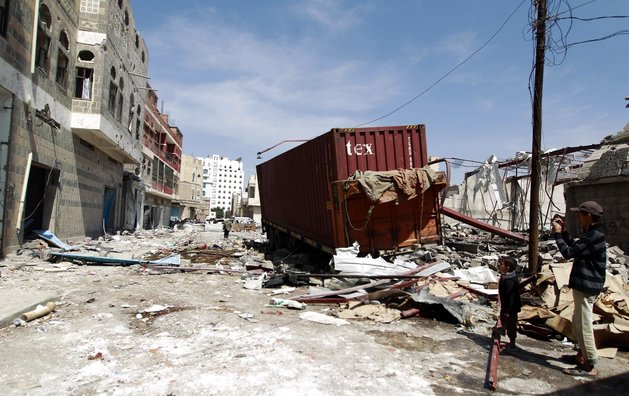
 Humanitarian catastrophe in Yemen  UN A man walks on the rubble of a of a house destroyed by Saudi led airstrikes that killed a TV director, his wife, and three children in Sanaa, Yemen, on Wednesday, Feb. 10, 2016 AP Photo Hani Mohammed


Amidst the chaos of the conflict, women in Yemen have increased vulnerability to gender based violence


ASSOCIATED PRESS A young boy takes a photo of houses damaged in Saudi-led airstrikes A hospital run by Doctors Without Borders was also hit in the attack.


The U.S. based Blackwater Group has reportedly abandoned the Ta'iz front in western Yemen after suffering heavy casualties over the last two months while


Yemen, Forgotten War, Forgotten War Crimes US Cluster Munitions Used against Civilians

Wednesday, February 10, 2016

Further thoughts on Syria and the contending interests

Some further thoughts on


The Great Powers contend for control of Syria because it is the path for transferring natural gas from the Pas field, the world’s largest deposit of natural gas, from the Persian Gulf towrope.  Iran an Qatar are the main contenders because they share the Pars field.


 Russia wants to prevent Qatar from selling to Europe because that would undercut Russia’s income from the sale of crude to Europe, harming its economy and, more importunately, its people. (Natural gas is cleaner and would sell better in Europe than crude).  Russia is not interested in the Islamic State; it is interested in Syria's having a government opposed to the Persian Gulf dictators, Oman excepted.  

Iran, which has half the Pars field, also wants to sell to Europe.  Russia thinks it can control the price Iran would sell and so would not hurt its market.  

The Saudi want to control Syria because it sees an opportunity to turn at least one country into another Wahhabist state, something it has tried for decades to do with no success because no people want to live to under Wahhabismic rule.

The US and Britain support the Saudi and oppose Iran for historical reasons.  The time for that position is past.  The West should as quickly as possible switch positions and support Iran.  

The switch cannot be quick in the US, because of the millions of dollars the Saudi spend lobbying Congress, but it can be done over time.  Weakening Saudi control over the price of oil would help the US economy.  That is in its national interest.  


The Saudi lobby is linked with the Israeli lobby, making the change even more difficult.  Regime change in Israel should be a prime objective of  Western governments. Now that China is supporting Palestinians, is to past time for us to be on Palestine's side.  Israel, too, needs to be friends with Palestine if it hopes to remain a democratic state instead of a totalitarian one.  It is in American Jews’ interest that Israel be aa democracy.

An immediate step the US and Britain should take is to withdraw all support for Saudi Arabia's genetical bombing o Yemen.  

Wednesday, February 3, 2016

Erdoğan's puwh for a sultanate is pushing Kurds toward Russia and Iran

This report is too wordy except for folks who on't know about Turkey's president, Recep Tayyip Erdoğan and his goal of becoming a new sultan of Turkey.

The more interesting part of the article is near the end, and deals with Kurdish strength.  

Remember that the Syrian Kurds and their Turkish partners are egalitarian, feminist, pluralistic, non-sectarian in their political outlook.  In that regard thy reflect all that was good about the Soviet Union.  Reports are so far silent about Kurdish attitudes toward capitalism, and --judging from Kurdish Iraq, shouldn't cause Washington problems.

 the Kurdish alliance with Russia and Iran is a natural alliance, given Erdoğan's shift toward a sultanate that excludes Kurds.  

That shift was caused by the EU's rejection of Turkey's application for membership, a slap in the face to Turkey's elite, that had altered its biases against women and minorities more that could be expected in anticipation of acceptance. 
Al-Monitor

Erdogan's Kurdish gamble
Turkish President Recep Tayyip Erdogan delivers a speech during a meeting on the new constitution at the Congresium in Ankara, Jan. 28, 2016. (photo by ADEM ALTAN/AFP/Getty Images)

Turkey’s strongman President Recep Tayyip Erdogan appears to have launched a campaign for a new constitution so he can shape the kind of presidential role he wants for himself.

Author Kadri GurselPosted February 2, 2016
TranslatorTimur Göksel
 Erdogan and his allied media have been harping for some time on the message that the parliamentary system in Turkey has become obsolete and must be replaced by a presidential system. Naturally, Erdogan has fully mobilized his Justice and Development Party (AKP) for that goal.
Erdogan is perfectly blunt about his goals and generously offers clues that eliminate the need for speculation. In a Jan. 28 speech in Ankara before representatives of civil society organizations that support him, Erdogan once again described the constitutional framework he wants for the regime, labeling it a “Turkish-style presidency.” 
According to Erdogan, the spirit of the new constitution should be based on the logic of "harmony and balance between powers instead of strife between powers — mutual support instead of antagonism." 
The question of executive rule has to be the core of efforts toward a new constitution. With the "absolute stability environment" that the presidential system will ensure, he says, Turkey will be protected from terror-related risks. 
All these remarks clearly reveal that Erdogan aspires to an authoritarian constitutional regime, to say the least. If Erdogan had been aiming at democracy, he would not have labeled and rejected the separation of powers as "strife among powers." He is advocating a concept that sidelines the control and balance mechanisms of democracies. 
This is beyond dispute: A regime in which executive power is key to the balance of powers, and all the executive powers are concentrated in the hands of the president, is nothing more than a dictatorship. Moreover, the "absolute stability" Erdogan refers to is a concept foreign to democracy but indigenous to dictatorships. 
Erdogan calls his authoritarian presidency regime “indigenous and national.” In his Jan. 28 speech, he used that label when he said, “The Turkish constitutions that have been written so far were … governed with imported commodities, with imported logic. … The constitution that will be based on our own traditions of governance will be a Turkish-style constitution.” 
Anyone who knows Turkey’s history will tell you concepts such as democracy, separation of powers, state of law, supremacy of law, human rights, equality, pluralism and the rest are imported from the West. The only governance tradition not imported from abroad but purely native comes from Turkey's former sultan rulers — despotism, absolutism and patriarchy.
If Erdogan is not referring to democracy when he talks about "Turkey’s established governance tradition," today’s reflection of that tradition cannot be anything less than an authoritarian regime. 
In crafting the constitutional framework he needs, we assume Erdogan will respect the valid clauses of the current constitution. Erdogan’s AKP does not have a three-fifths parliamentary majority to get the presidential constitution amendment approved and submit it to referendum. In such a vote, the AKP would have to ensure that all its deputies would vote for the amendment, while acquiring the support of at least 14 deputies from opposition parties.
If those 14 opposition deputies cannot be found, the only way to find a parliamentary majority for the amendment would be to take the country to an early election. Of course it will not be easy to lead this country, which went through two general elections in 2015, to a new election without convincing reasons. 
We can surmise that Erdogan's regime will follow this type of scenario in the coming days: 
First, Erdogan, his media and government spokesmen will ramp up the campaign to persuade Sunni conservative voters that the presidential regime is urgent and vital. The moment public opinion polls indicate those voters perceive the presidential regime as a historical and unavoidable necessity, the campaign for an early election will be launched. 
The regime will justify the need for an early election with the allegation that opposition parties are clogging up the country's progress. As such, a new blessing is needed from the voters. 
Prime Minister Ahmet Davutoglu indicated in a Jan. 26 speech before parliament that he does not favor early elections. 
Davutoglu said, “There are those who are trying to confuse minds with baseless speculation about early elections. Let me state openly and clearly that Turkey, which achieved democratic stability in the Nov. 1 elections, has no need for an early election today.” 
We are aware, however, that Davutoglu’s words do not mean all that much, given Erdogan’s dominant power. If Erdogan persists in taking Turkey to a presidential system, the only way to avoid an early general election is to seduce 14 opposition deputies to support the constitutional draft. Therefore, a new voting process in 2016 appears likely, whether for a constitutional referendum or an early election

One of the most prominent elements of the Machiavellian game that will be played until the Turks go to the voting booth will be the threat of terror and chaos. 
Fear of chaos was the top factor that enabled the AKP to recover in the Nov. 1 elections the parliamentary majority it had lost in June. It's the same threat that prompted Sunni conservative voters to restore the AKP to power Nov. 1. An important pertinent signal came from Islamist daily Yeni Akit, an ardent Erdogan supporter, in a Jan. 28 article titled “Either presidency or chaos.” 
Leaving aside the Islamic State (IS) terror that has not yet become a permanent feature, the only element that keeps the chaos and terror threat alive is the war that was launched July 24 against the Kurdistan Workers Party (PKK). 
Reaching an agreement with the Kurdish movement could mean loss of nationalist votes that the government wants in a referendum or elections. That could also mean more votes for the Kurdish Peoples' Democratic Party (HDP). But in an early election, Erdogan’s goal is to push both the opposition Nationalist Action Party and the HDP to below the 10% election threshold. If that is secured, then all the seats they would have won will be accrued to the next-strongest party — the AKP. That of course would guarantee enough seats for the AKP to get a constitutional amendment.
It is impossible for the ongoing war to bring about a military solution to the Kurdish question, given the regional power level the PKK has reached and its strategic depth in Iran, Iraq and Syria. Moreover, the battle is not being waged to solve the Kurdish issue; it is being waged to gain a presidential system. 
The war is creating its own realities. In some towns where the Kurdish movement is truly powerful, Turkey's use of tanks and artillery to overcome the resistance is generating destruction similar to that in Syria. Kurdish civilians are being collectively punished with extreme human rights violations that leave them no choice but to emigrate. It will not be easy to manage the massive social and political costs this disaster entails. 
Moreover, it is impossible to treat this war separately from the Syrian crisis that could turn the Turkey-Russia cold war to a hot strife at any moment. Turkey, with its own hands, is pushing the Kurdish movement to Russia and now risks losing control of its Kurdish issue because of the raging war in the southeast.

Saturday, January 30, 2016

The Neocons failed strategy in the Middle East. Again. And again.

The author of he following article, The Truth About Sectarianism, Jacob Olidort, is   a Soref fellow at the Washington Institute for Near East Policy.  Olidort is impressively educated and is well-connected in Washington, working for both Bushes, Clinton, and Obama.

His article does not distinguish between Saud Wahhabism and Salafi Jihadism as it should.

Th article ignores the $Billions in financial and political support the Saudi and other Gulf dictators have given to Salafi Jihadism is Syria and, for decades, to madrases throughout Central Asia that teach hatred of the West.  Support for Syrian Salafi is one of the main obstacles to a political settlement of the strife in Syria.

Olidort's does not condemn the Saud genocide in Yemen but instead focuses on the death of one cleric, displaying a bias in favor of the Saud and its Western allies.  The US and Britain are complicit in the genocide.


 Olidort does not mention the UN Panel of Experts' report that Abdullah Saleh, former president of Yemen, took as much ass $60 Billion in Yemeni money when he was forced out of the presidency by the Arab Spring.  The money was taken with Saud approval and US complicity, and is now used to fuel the popular rebellion that riggers Saud carpet bombing of the country.  Leaving Saleh with so much money was a mistake.  Starving Yemeni could use $60 Billion.

A more useful article, by  Olidort, published by the Washington Institute, is What is Salafism?, recommended for those of you who are curious.

Per Wikipedia,, the Washington Institute,where Olidort works, has been criticized as "'the fiercest of the enemies of the Arabs and the Muslims'", and describing it as the "'most important Zionist propaganda tool in the United States.'"  The institute vigorously objects.

Olidort does not think is is productive to try to change Saudi Arabia or Iran from a sectarian government.  In stead, he recommends this:
A better allocation of U.S. attention and resources is to deter exploitative acts by institutional sectarians such as Saudi Arabia or Iran. This can only be done by assuming an engaged leadership role in the region—for example, working with local societies in rebuilding their infrastructure so that they do not turn to sectarian alternatives.
Eisenhower build dams to provide water to sectarian Pashtun in Afghanistan.  The Pashtun used the water to grow opium poppies and hate America and Russia with equal fervor.

See where  that got us.

Neoconic advice from its inception.

 
THE TRUTH ABOUT SECTARIANISM
Published by the Council on Foreign Relations
Behind the Various Strands of Shia-Sunni Discord
By Jacob Olidort
Sectarian identities were supposedly formed in the Middle East centuries ago, and yet they seem to breed the region’s bloodiest conflicts today. While Iran has thrown its support behind President Bashar al-Assad in Syria and the Houthi rebels in Yemen, Saudi Arabia has strategized on how to bring both of them down. Tensions deepened earlier this month after Saudi Arabia enraged Iran by executing a prominent Saudi Shiite cleric, whom the regime claimed was a terrorist. When Shiites protested in Iran and Saudi Arabia, sometimes violently, the Kingdom kicked Iran’s diplomats out of the country.

But the conflict in the region is much more nuanced than a simple sectarian war. Saudi Arabia’s rhetoric, for example, which is governed by a deeply entrenched Wahhabism, is very distinct from the Islamic State’s (also known as ISIS) use of anti-Shiism to exploit political and economic grievances against both Assad’s Shiite–Alawite regime and the dispossession of Iraq’s Sunnis under the government of then-Prime Minister Nouri al-Maliki.

In fact, there are three broad kinds of sectarianism at play. Some groups and states have integrated sectarian themes into the very fabric of their political, cultural, and educational systems. Sectarianism, in other words, has been institutionalized. The most prominent example is, of course, Saudi Arabia and its centuries-old antagonism towards Shiites. Muhammad ibn Abd al-Wahhab, known as the father of Wahhabism and who was present at the state’s founding, made anti-Shiism a core component of his doctrine. Another example is Iran. Ruhollah Khomeini, leader of the Iranian Revolution and later Iran’s supreme leader, developed a theory of Islamic government known as “governance of the jurists.” He argued that Muslims should live under a regime overseen by legal scholars, and in particular, those trained in his Shiite tradition, who are skilled in interpreting Sharia law. His theory shaped the founding tenets of the Republic.

 
RAHEB HOMAVANDI (TIMA) / REUTERS
Protesters holding pictures of Shiite cleric Sheikh Nimr al-Nimr are pushed back by Iranian riot police during a demonstration outside the Saudi Arabian Embassy in Tehran, January, 3, 2016.

Even some non-state communities, such as the Salafists, have institutionalized their sectarianism. Salafists claim that their conservative version of Sunnism adheres to a literal understanding of the faith that the Prophet Muhammad and his earliest followers practiced. They thus consider Shiites apostates. Although lacking (and in most cases even resisting) the call for a state, Salafists have systematized their opposition to Shiites over the course of the twentieth century by promoting medieval theological treatises that support their theology. In the 1960s, they even began teaching Salafism at Islamic universities in Saudi Arabia and at Wahhabi institutes around the world.

At the other end of the sectarian spectrum, incidental sectarianism, as its name implies, does not involve a deliberate effort to implement a sectarian agenda. Sectarianism does not play a central role in a state or group’s objectives, even if there are overtones of it. The most pertinent example is the Syrian civil war. It began as a conflict centered on regime change. In fact, the Assads have deliberately downplayed their Alawite affiliation precisely because it is seen as heterodox by the more dominant Twelver Shiism in Iran. To secure power and legitimacy, former President Hafez al-Assad, Bashar’s father, therefore allied with other Shiite groups within the region, such as in Lebanon. Although there is certainly a sectarian dimension to the Syrian conflict, it is not an institutionalized part of either the war or the actors involved; it has been incidentally ascribed. The same is true of the Houthi rebels in Yemen, who belong to the minority Zaydi sect, but are not fighting the regime for sectarian reasons.

Finally, there is exploitative sectarianism, a category that characterizes the tactics and nature of many of the most violent actors in the region. ISIS, for example exploits the local power vacuum in order to build up its capabilities and amass territory. A number of Syrian opposition groups, such as Ahrar al Sham and al Nusra Front, also push a sectarian narrative in order to achieve their political goals, whether it’s to turn Syria into their version of a stable Sunni state or simply overthrow Assad. To be clear, these groups are all equally committed to their sectarian principles, but not all of them have gone as far as, say ISIS, in institutionalizing their beliefs, politically and socially.

Developing a long-term strategy for sectarian conflicts requires understanding that not all sectarianism is the same. [Emphasis in the original]
This three-tiered classification system is also a useful guide for understanding how players in the region behave. Institutional sectarians such as Saudi Arabia and Iran can also act exploitatively, that is, inject a layer of “incidental sectarianism” into an otherwise non-sectarian conflict, as we’ve seen in Syria and Yemen. Saudi Arabia also exploited its penal code to amplify the sectarian dimension of regional geopolitics by executing a high-profile Shiite figure. While precise motives are hard to identify, Saudi Arabia likely sought to elicit an aggressive Iranian response just as sanctions were being lifted or, as some have acutely suggested, remind the United States that it can stand up to Iran on its own, particularly when Washington refuses to do so.

Exploitative players might also learn to institutionalize their behaviors. We see this with ISIS. It is actively seeking to establish a system of governance—whether it’s issuing edicts on how to treat minorities or designing educational curricula. This process builds channels for ISIS to apply and perpetuate its doctrines, as well as gain credibility from those around the world who share its vision. The same is true of Syrian opposition groups. Al Nusra Front and Ahrar al Sham have set up courts and judiciary bodies that mete out their version of justice. It is worth noting that, like ISIS today, the first Saudi state, which was founded in the eighteenth century, also emerged out of a political vacuum by taking advantage of territorial opportunities created by regional neglect.


TIMA (MEHDI GHASEMI) / REUTERS
Flames rise from Saudi Arabia's embassy during a demonstration in Tehran, January 2, 2016.


Understanding the dynamic nature of sectarianism will enable the United States to respond more effectively to emerging sectarian challenges. For starters, Washington must understand that it is not constructive to disrupt institutionalized sectarianism. The United States, for example, is not able or welcome to change Saudi or Iranian societal norms, however disagreeable. A better allocation of U.S. attention and resources is to deter exploitative acts by institutional sectarians such as Saudi Arabia or Iran. This can only be done by assuming an engaged leadership role in the region—for example, working with local societies in rebuilding their infrastructure so that they do not turn to sectarian alternatives.

The same method can be applied to fighting exploitative groups such as ISIS. Although U.S. counterterrorism has recently embraced the concept of “countering violent extremism,” these efforts will eventually drag Washington down an ideological rabbit hole because it is not within the physical, legal, or political purview of the U.S. government to counter extremist narratives, which often have historic roots; for example, Sunni hostility towards Shiites for venerating their imams (and thereby, according to Sunnis, violating the principle of God’s oneness) is a polemic that can be traced back to Sunnism’s formative period. How would the United States even begin to counter that narrative?

A more reasonable initiative involves taking note of how exploitative actors use sectarian themes to their own advantage. Although Salafist literature is chock full of hatred for Shiites, it is jihadi–Salafist groups like al Qaeda and ISIS that use it to justify violent actions towards Shiites and other non-Sunni Islamic groups. Rather than proposing alternatives to these sectarian doctrines, Washington should focus on preventing these delinquents from institutionalizing their violent vision through schools and bureaucracies that perpetuate these ideas. If left unchecked, the tone and type of sectarianism that will likely be institutionalized will be ever bloodier and, perhaps, more attractive to potential recruits. That is why developing a long-term strategy for sectarian conflicts requires understanding that not all sectarianism is the same.


Some images of Saudi bombing in Yemen in the past month, from google images:

People gather at the site of a Saudi-led air strike in Yemen's capital Sanaa January 6, 2016 Khaled Abdullah  Reuters


Three medical facilities run by Doctors Without Borders have been bombed in the past three months in the Saudi-led war in Yemen, while human rights organizations have accused the US backed coalition of war crimes for targeting civilian areas


Yemeni workers inspect the damage at a factory after it was reportedly destroyed by Saudi-led airstrikes in the capital Sanaa (AFP Photo/Mohammed Huwais)

Wednesday, January 27, 2016

A couple of points of interest in this al-Monitor report, highkighed in blue,  blog editorial comment in red:

Al Monitor
TURKEY PULSETÜRKİYE'NİN NABZI
US Vice President Joe Biden (L) speaks during a joint news conference with Turkish Prime Minister Ahmet Davutoglu in Istanbul, Jan. 23, 2016. (photo by REUTERS/Murad Sezer)

How Biden annoyed Ankara during his recent visit to Turkey
The high-profile visit by US Vice President Joe Biden to Turkey last weekend produced little satisfaction and much annoyance in Ankara, especially with regard to Washington’s position on the state of democracy in Turkey and on certain developments in Syria.

Summary⎙ Print Was the US vice president's awkward talks with the Turkish president and prime minister a harbinger of even more tension in already strained ties between the two countries?
Author Semih IdizPosted January 26, 2016
Many analysts see Biden’s awkward talks with President Recep Tayyip Erdogan and Prime Minister Ahmet Davutoglu as a harbinger of tense moments to come in what are already strained ties between the two countries. Few, however, expect a break in ties because neither can afford that.

Ankara expected criticism from Biden with regard to what independent human rights organizations and media watchdog groups say is the hounding of journalists critical of the government’s policies and academics opposed to its current war against the Kurdistan Workers Party (PKK).

The government’s irritation, however, intensified when Biden met members of civil society groups and prominent journalists known to be in the government’s crosshairs, expressing solidarity with them ahead of talks with Erdogan and Davutoglu.

"When the media are intimidated or imprisoned for critical reporting, when Internet freedom is curtailed and social media sites … are shut down and more than 1,000 academics are accused of treason simply by signing a petition, that’s not the kind of example that needs to be set," he told reporters. Biden was referring to the imprisonment of Can Dundar, the editor-in-chief of Cumhuriyet who is in prison for reporting on the government’s illegal arms shipments to anti-regime groups in northern Syria.

He was also referring to the 1,128 academics being investigated for a petition they signed against the way the government has been conducting its war against the PKK, involving great collateral damage.

Ankara’s answer to Biden was not long in coming. “Encouraging terrorism is a crime anywhere in the world. I don’t know who prepared Mr. Biden’s program, but it is clear they did not want him to see the full picture of what is happening in Turkey,” Davutoglu told reporters prior to meeting Biden. 

The pro-government media was also quick to lambaste Biden. Under the headline “Look who's talking,” a Yeni Safak editorial argued that 75 academics had been fired in the United States for claiming Washington was behind the 9/11 attacks. It also claimed that criticizing Israel was illegal in the United States and went on to ask whether Biden was also in solidarity with whistleblowers Edward Snowden and Julian Assange. 

However, differences with regard to the Democratic Union Party (PYD), the umbrella organization of the Syrian Kurds, and the Peoples Protection Units (YPG), its military wing, emerged as the principle stumbling block in Biden’s talks with Davutoglu and Erdogan. Turkey considers the PYD and YPG terrorist organizations because of their links to the PKK. The United States, however, has allied itself with these groups in Syria and does not treat them as terror groups.

Ankara is now demanding that the PYD be barred from the Geneva talks on Syria, but appears to have made little headway in this respect during Biden’s visit. Differences on this score were also visible during the joint press conference Davutoglu and Biden held after their talks.

Despite Davutoglu’s multiple references to the YPG as a “terrorist group,” Biden restricted himself to merely saying that the United States supports Turkey’s fight against the PKK and studiously refrained from addressing either group.

Turkey is said to be considering boycotting the Geneva talks if the PYD is represented there in any shape or form. Murat Yetkin, the editor-in-chief of Hurriyet Daily News and a prominent columnist for Radikal, explained the reasons behind Ankara’s strong opposition to the PYD.

“Ankara, for security reasons, does not want a PKK-linked Kurdish group controlling an entire belt along the 910-kilometer [565-mile] Turkish-Syria border. The Turkish government thinks that a stronger PYD means a stronger PKK, which could further antagonize Turkey’s terrorism problem originating from the Kurdish issue,” Yetkin wrote for Hurriyet Jan. 26.

[Not to mention that such a corridor would permit Iraqi Kurdistan to deliver oil directly to Europe, rather than through Turkey, which would enable Iraqi Kurds to declare independence from Iraq, encouraging Turkish Kurds in their own independence efforts.  Such a corridor i entirely consistent with Western and American interests, hough not with Turkish interests; hence the conflict.] 

Pointing to a “complicated picture,” Yetkin said that boycotting the Syria talks “could make life difficult for the Turkish government.” He added, however, that “it would not make it easier for other countries and parties” either. 

Retired Ambassador Unal Cevikoz, who lectures on international politics at Istanbul’s Kadir Has University and also writes for Radikal, pointed out that the PYD does not just have US support, but also the support of Russia and Iran.

“They consider the PYD one of their most important allies in the fight against [the Islamic State] in Syria and believe it has to have a place in the future Syria,” Cevikoz argued in his column earlier this w

Cevikoz went on to maintain that Ankara’s insistence on opposing the PYD was also leading many countries to question whether Turkey is sincere when it says it wants to see a swift end to bloodshed in Syria.

[Iranian and Russian support for PYD greatly strengthens the group, and is good to see.

Ahmet Unal Cevikoz is an accomplished Turkish civvil servant as well as an respected educator.  See  Ahmet Ünal ÇeviközVikipedi, özgür ansiklopedi (Turkish Wikipedia)]


While meeting Biden in the plush surroundings of Istanbul’s Ottoman-era Yildiz Palace, Erdogan reportedly also stressed that the PYD was a terrorist organization that must not be at the table on Syria.

Tellingly, however, the press conferences planned for after the Erdogan-Biden talks was canceled, fueling speculation that the sides did not want their differences on this and other issues to be come out in front of the media.

Yasin Aktay, a deputy from the ruling Justice and Development Party who is also a columnist for Yeni Safak, argued that the US side would suffer the consequences of remaining deaf to Ankara's exhortations about the PYD.

“The US has already damaged the understanding between allies by supporting the PYD and its extensions, which are involved in acts of enmity against Turkey,” Aktay wrote in his column. He went on to warn that the price of cozying up to a merciless terrorist organization could be losing Turkey‘s friendship.

One topic on which a partial agreement was reached during Biden’s visit was the question of Turkey’s controversial deployment of forces in Bashiqa, near Mosul. Iraq considers the move a violation of its sovereignty and has demanded that the Turkish troops be withdrawn.

In a recent phone conversation with Iraqi Prime Minister Haider al-Abadi, President Barack Obama also called for the Turkish troops to be withdrawn and demanded respect for Iraq’s territorial integrity and sovereignty. 

Unidentified Turkish officials told the press later that the sides had decided during Biden’s visit to “strengthen coordination and proceed with new initiatives on the Bashiqa camp,” though they did not elaborate.

Deniz Zeyrek, the Ankara correspondent for Hurriyet, cited unidentified sources as saying that the camp in Bashiqa, where a small number of Turkish soldiers have been training local forces against IS, will be turned over to the US-led coalition.

According to the arrangement, the Iraqi forces will also have a presence there to reaffirm Iraqi sovereignty. The deal, however, has not been finalized because Baghdad has yet to endorse it.

The bottom line is that divisions between Ankara and Washington were not bridged during Biden’s visit. All signs indicate that disagreements between the two countries on these issues will continue. This does not mean, however, that there will be a break in ties.

Turkey’s need for the United States has increased after its relations with Moscow soured to the point of near-enmity following the downing of the Russian jet in November. Washington’s need for Turkey, on the other hand, especially with regard to using strategically placed Turkish bases in the fight against IS, will also continue for the foreseeable future.

Most analysts agree that this mutual dependence will ultimately ensure that the sides continue to stress their relationship as a “strategic partnership."