Showing posts with label Egypt. Show all posts

Wednesday, May 27, 2015

A difficulty of Governing Egypt and some sympathy for Fattah al-Sisi

This news  story, reported so far as I can see  in English only in al-Monitor, gives me a small degree of respect for the Egyptian Tyrant,  Fattah al-Sisi.

Looking at certain parts of Tennessee , Oklahoma, and Texas and reading material sent to me by old friends, I try to imagine the Unite States dominated by three fervent fundamentalist Christian parties and one secular one; and each of the Christian parties interprets passages of the Old Testament to mean different commands which must be followed.

Here is one example of the problems such a president might face if confronted with such apolitical world.

A passsage from the Book of Deuteronomy , a book of the Christian Old Testament, believed by some Christians to the the Entrant Word of God…

Deuteronomy 21:18-21King James Version (KJV) 
18 If a man have a stubborn and rebellious son, which will not obey the voice of his father, or the voice of his mother, and that, when they have chastened him, will not hearken unto them: 
:19 Then shall his father and his mother lay hold on him, and bring him out unto the elders of his city, and unto the gate of his place; 
20 And they shall say unto the elders of his city, This our son is stubborn and rebellious, he will not obey our voice; he is a glutton, and a drunkard. 
21 And all the men of his city shall stone him with stones, that he die: so shalt thou put evil away from among you; and all Israel shall hear, and fear.

A legislator in Tennessee has proposed that a city council, when presented with a stubborn and rebellious child, should be authorized to stone the child to death, on the authority of the passage just quoted.

And then I try to imagine what a president would have to do to govern such a country.  A military dictatorship  makes sense in such a situation.

Egypt is aced with just such a situation.


Al-Monitor, May 26, 20115

Sisi's call for religious tolerance divides Muslims 
CAIRO — On the occasion of the Prophet Muhammad’s birthday, President Abdel Fattah al-Sisi on Jan. 1 gave a speech in which he called for a religious revolution against extremism. He said there are ideas and texts in Islam that have been sanctified over hundreds of years and cannot be ignored. These erroneous ideas, however, have painted a bad picture of the Muslim nation as one characterized by killing and destruction, he said. It has been almost five months since Sisi's speech, in which he also blamed Al-

for rekindling such religious rhetoric. Although the goal of Sisi’s speech was to encourage tolerance and eliminate sectarian polarization, each Islamic current interpreted his words to suit its own ideas and beliefs. 
The Salafists, among them Sheikh Mohammed al-Abasiri, demanded the cancellation of Sufi holidays because of their alleged unethical and un-Islamic practices. Meanwhile, Sufi sheikhs, including Mohammed al-Shabrawi, called for the rejection of Salafism, because, he claimed, the Wahhabi ideology is the main reason behind the spread of terrorism in Egypt. 
Secularists meanwhile launched fierce verbal attacks against Al-Azhar, blaming its sheikhs for the country’s problematic religious discourse. The Al-Azhar sheikhs retorted that the secularists were trying to strip Egypt of its Islamic identity. The Muslim Brotherhood rejected Sisi’s call, which it said was directed against Islam, accusing Sisi of being unjust to Muslims and asking Muslims to disregard their holy texts. 
In an April 2015 speech at the Egyptian Military Academy, Sisi said that his call for religious reform had been incorrectly interpreted.
Ahmad Karima, professor of comparative jurisprudence at Al-Azhar University, told Al-Monitor, “Religious discourse can be divided into two parts. The Sharia texts, which are the Quran and the authentic hadith, constitute the first part, and one cannot go against them. The second part entails the Muslim scholars’ understanding of these texts, and this understanding is debatable and amendable.” 
Karima said religious discourse can be modernized through education reform, especially the reform of texts that rely on inaccurate information passed down for generations. Karima cited the “History of the Prophets and Kings” as an example of a historical source that includes false information, such as that Abu Bakr al-Sadiq was the first caliph to burn a man to death. 
Karima also claimed that it is important that only academics specialized in Islamic preaching be allowed to speak publicly in places of worship and that unqualified individuals, like many Salafists, be forbidden to preach. According to Karima, Al-Azhar graduates in audiovisual and printed religious media should be put to work in this respect, because the religious media arena is so chaotic that anyone can become involved in it.
The Islamic researcher Islam al-Buhairi disagreed that it should be Al-Azhar’s mission to modernize religious rhetoric. “The only obstacle to the reform of religious rhetoric is Al-Azhar itself,” he told Al-Monitor. “It cannot rectify anything because ideological corruption stems from within [that very institution]. How, then, can the reform take place?” 
He further stated, “Sisi has asked Al-Azhar men four times on different occasions to modernize religious rhetoric, but they did not move a finger, and they won’t. This is what pushed me and other thinkers to assume this responsibility.”
Mohammad al-Shahat al-Jundi, a member of the Islamic Research Council and former secretary-general of the Supreme Council for Islamic Affairs, told Al-Monitor, “After Sisi’s call for a religious reform revolution, Egyptian media [began spreading] the opinions of non-specialists, questioning the holy hadith and mocking the Prophet's companions in a way that does not reflect wisdom, truthfulness or professionalism. [They propose] such religious hypotheses [that] carry an underlying organized and deliberate campaign to push Al-Azhar into a manufactured conflict. The aim is to distract Al-Azhar from its pivotal role in fighting takfir, sectarianism and division at a highly critical time for the Muslim nation and for the country.” 
Mohamed Zaki, secretary-general of the Supreme Committee for Islamic Preaching at Al-Azhar, which oversees Islamic preaching globally and locally, told Al-Monitor that the committee, which includes several government ministers, including the minister of education, has not convened since 1983. Since he became committee chair, almost a year ago, he has asked Al-Azhar’s sheikh several times to call a meeting, but there has been no response. 
Nader Bakkar, co-founder of the Salafist Nour Party, told Al-Monitor, “The failure of the religious reform revolution stems from the lack of a unified and grounded scientific discussion. Each party has its own perspective and driving forces and is not willing to cave in to maintain the trust of its advocates. The heritage books constitute a good starting point for this revolution. Al-Azhar clerics, intellectuals and researchers from outside Al-Azhar, in addition to statesmen who have the executive power to set scientific foundations, can meet to reform heritage books and eliminate the parts that are now only applicable to the distant past. Some opinions [expressed by] Islamic scholars are correct, while others are relative or belong to certain eras. Other opinions are just plain wrong, because people can make faulty judgments.” 
Sheikh Mohammed Abu al-Azayem, head of the World Federation of Sufi Orders, said, “Closing the door on juristic deduction has resulted in this backwardness in the religious rhetoric. The Muslim people have become bound by ideas that date back a thousand years, such as the [outmoded] four imams’ approach adopted by the Salafists.” 
The modernization of Islamic rhetoric remains lost amid the slew of ideologies in Egypt and various media-driven representations, some of dubious value.

---------- 

Children and adults are now stoned to death in compliance with various 
interpretations of Muslim religious law.


Saturday, April 18, 2015

A reason for the Saudi and Somali bombing of Aden

A recent quotation from the BBC that helps explain the reasons for the most recent Saudi aerial bombing in Yemen [emphasis added]:

After rebel forces closed in on the president's southern stronghold of Aden in late March, a coalition led by Saudi Arabia responded to a request by Mr Hadi to intervene and launched air strikes on Houthi targets. [Note:  Mr. Hadi was a "guest of the Saudi when he made the "request"]   The coalition comprises five Gulf Arab states and Jordan, Egypt, Morocco and Sudan.  . . .
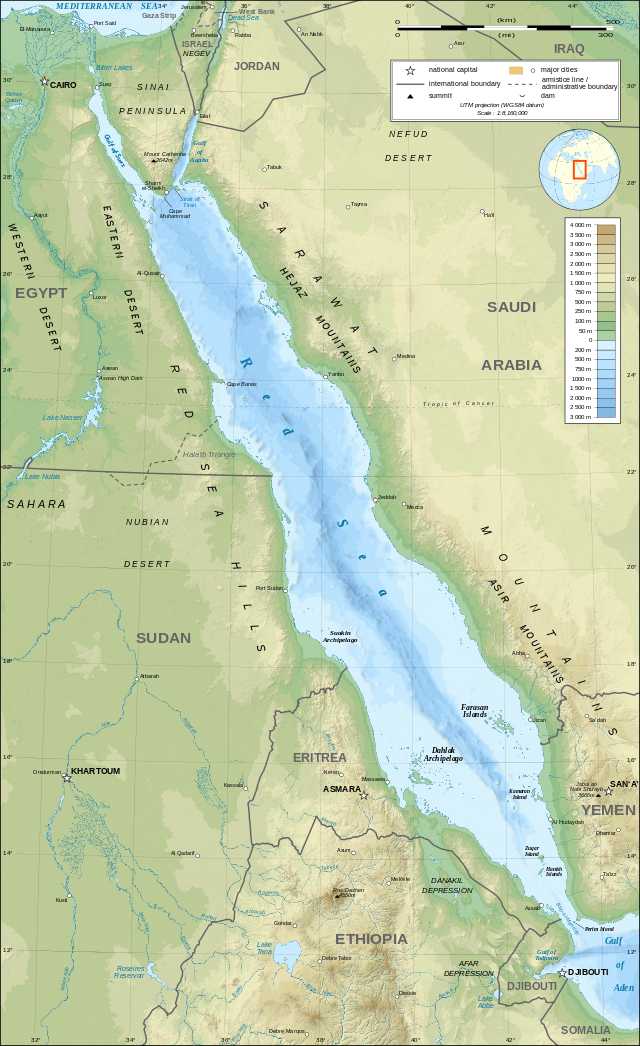
Yemen is strategically important because it sits on the Bab al-Mandab strait, a narrow waterway linking the Red Sea with the Gulf of Aden, through which much of the world's oil shipments pass. Egypt and Saudi Arabia fear a Houthi takeover would threaten free passage through the strait.

Yemen crisis: Who is fighting whom? - BBC News


∼∼∼∼∼∼∼∼∼∼∼∼∼∼∼∼∼∼∼


 Bab al-Mandab has been occupied by homo sapiens for 6-,000 years, whth varying success.

From Wikipedia:

Haines[disambiguation needed] stated that it could become a major trading centre and the latter part of the British period proved him correct with Aden growing to become one of the busiest ports in the world. In 1838, under Muhsin bin Fadl, Lahej ceded 194 square kilometres (75 sq mi) including Aden to the British. On 19 January 1839, the British East India Company landed Royal Marines at Aden to secure the territory and stop attacks by pirates against British shipping to India. The port lies about equidistant from the Suez Canal, Mumbai, and Zanzibar, which were all important British possessions. 

The Suez Canal was open in 1869.  The Bab al-Mandab strait has been important to world commerce since then.


Thursday, April 2, 2015

Some Middle East Conundrums

If you want to know why secretaries of state go mad, consider:

—  The US has been droning Qaeda men in South Yemen and giving billions to Yemen’s dictators to fight them, and Qaeda in the Arabian Peninsula is now one of the strongest brands of radicals there is; 

— The Southern Separatists, inclined to favor British governance, originally opposed Qaeda but began to support it when drones killed many of their relatives, without cause or explanation; 

— The quasi-Shia Houthi are fighting the radical Sunni Qaeda in Aden - the principal city in South Yemen, aiding the US objective there; 

— The Saudis are bombing the Houthi, falsely claiming that the Houthi are a tool of Iran whom we hate and love, because they fear that Houthi power will spread to the Shia who make up a majority of the residents of of the Saudi Eastern Province, their main oil producing province;

— The US is providing the Saudi with logistical support, while continuing to fight Qaeda;

— Thee Saudi have asked Pakistan for boots on the ground to help it in it’s defense and offense, since its military is ineffective, and Pakistan is wavering on joining the Saudi bombing of Yemen, fearing that doing so will make their own Shia-Sunni divisions  worse;

— The Coalition of Five which is negotiating with Iran over the Bomb has differing positions, making it hard for Iran to agree to anything;

— Israel, should be worried more about the Egyptian-Ssaudi-Pakisani military cabal now taking shape more than about Iran;;

— That cabal consists of  our “friends" in the Middle East,  nations to whom we give billions a year.

—  Kerry does not sleep well.  Neither would you, if you had to hold all this together.

— Obama sleeps well, content to do the best he can in the circumstances.  I think.


The New York Times
Qaeda Militants Attack Port City in Yemen, Freeing Prisoners
By SAEED AL-BATATI and KAREEM FAHIMAPRIL 2, 2015

 AL MUKALLA, Yemen — Militants from Al Qaeda’s Yemeni affiliate stormed this southern port city early on Thursday, attacking several government buildings including the central prison, where they freed hundreds of inmates, according to residents.
It appeared to be the first large-scale operation by the affiliate, Al Qaeda in the Arabian Peninsula, since the beginning of a military offensive led by Saudi Arabia onYemen more than a week ago, and a further expansion of the violence rapidly spreading across the country.
In an apparently coordinated offensive that began after midnight, the militants attacked security headquarters, the presidential palace and other official installations. That appeared to be intended as a diversion before the militants attacked the central security prison, their primary target.
Witnesses near the prison said they saw hundreds of inmates file out. Afterward, looters descended on the prison, they said.
  • Al Mukalla, the capital of the oil-rich Hadhramaut Province, had been spared much of the recent unrest in Yemen’s accelerating war. The fighting began in earnest weeks ago in the southern port city of Aden, where forces loyal to the president of Yemen, Abdu Rabbu Mansour Hadi, who is now exiled, clashed with allies of the Houthis, a northern militia that controls the capital and forced Mr. Hadi from power.
Last week, Saudi Arabia and a coalition of countries, with support from the United States, began a broad military offensive against the Houthis, ostensibly aimed at restoring Mr. Hadi to power. Many have begun to question the aims of the military campaign, as the Houthis have continued to advance, including deeper into Aden, and the toll of the fighting on Yemeni civilians has become increasingly severe.
The attack on Thursday was the first indication of how Al Qaeda was capitalizing on the growing anarchy, at a time when Yemen’s American-trained counterterrorism troops have come under attack by the Saudi-led military coalition.
A similar attack by Al Qaeda in late March on a town in Lahj Province forced the Obama administration to withdraw its last military advisers to Yemen, who were stationed at a base near the town. The administration has said it is providing intelligence, logistical support and targeting guidance to the Saudi-led campaign.
Explosions and gunfire could be heard throughout Al Mukalla overnight. Clashes continued in the city later on Thursday morning, as local military units backed by helicopters fought gun battles with militants in Al Mukalla’s old city, according to witnesses.


————  ———————————


Wednesday, December 7, 2011

Obama No. 1; Perry hacken' 10; never again Perry's world

The Guardian on 6 December 2011 noted that President Obama has

 told US officials to consider how countries treat its gay and lesbian populations when making decisions about allocating foreign aid.
Reactionary presidential candidate and Texas Governor Rick Perry issued this Statement on the president's decision:


 "This administration's war on traditional American values must stop.

"This silly idea is just the most recent example of an administration at war with people of faith in this country. Investing tax dollars promoting a lifestyle many Americans of faith find so deeply objectionable is wrong."
This "silly idea" is the subject of a  chilling comment by the admirable and beautiful blog another country:


 Iran Celebrates the End of Ramadan:
Six hanged in the City of Ahvaz,
Three of Them for "Lavat" (sexual intercourse between men)


If you ain't moved by another country's comment, you ain't my kinda folk.

The Guardian article quotes Secretary of State Hillary Clinton as saying


"I am not saying gay people can't or don't commit crimes," she said. "They can and they do, just like straight people. And when they do, they should be held accountable. But it should never be a crime to be gay."
Quite right, Madam Secretary.  You'd have made a great president, too.


I yearn for the day when Governor Perry is nominated by The Reactionary Party and is on a debate platform with Barak Hussein Obama, explaining why persons with "traditional American Values" insisted on by "many Americans of faith" would celebrate hanging young Texans from a sour apple tree.


The Guardian article notes:


The 10 countries granted the greatest economic and military assistance from the US – according to USAID – are Afghanistan, Iraq, Israel, Egypt, Pakistan, Sudan, West Bank/Gaza, Ethiopia, Kenya and Colombia.

In Israel, gays are more free than in Texas, excepting Austin.  Columbia, to my astonishment, is moving toward freedom.  The rest of the countries to which we give untold amounts of money gladly murder gays.

Do you, any of you, remember John Rechy's  City of Night (1963),

http://likedreamsville.blogspot.com/2008/12/john-rechy-city-of-night.html


 or his Numbers (1967)?


These autographical novels are the moving and mad adventures of a desperate  youngman [Recy's phrase] in the Perryesque America as I lived it in the 50s and early 60s.  Rechy's depiction of El Paso and Los Angeles reminds me of Egypt today:

From Wikipedia:

Egypt is influenced by the civil law system [note from Durell:  derived from Roman law, as is the law of France, Germany, Italy, and most European countries, England excepted). As the criminal code is silent on the subject of private, adult and consensual homosexual acts, and cross-dressing, they are not de jure illegal in Egypt. However, since 2000 certain laws have been used to impose what amounts to a de facto ban on homosexuality and cross-dressing.
In 2000, police arrested an Egyptian gay couple and charged them with, "violation of honor by threat" and "practicing immoral and indecent behavior". Their lawyer asked that the charges be dropped because homosexuality is not a crime, but the judge refused on the grounds that two men had in fact "offended" religious and moral standards [1]. The incident became a media sensation, promoting various public figures to view homosexuality as a product of Western decadence and demand that the government execute homosexuals or send them to mental institutions to be reformed[2].
Within a year, the Egyptian government began a public crackdown on Egyptian gay men by raiding private parties, arresting the guests and charging them with various laws, including violating the "Public Order & Public Morals" code, enacted in the 1990s to combat "Satanic" and "lewd" expressions, as well as engaging in prostitution and "violating the teachings of religion and propagating depraved ideas and moral depravity." [3].

If the Muslim Brotherhood (Egypt's expression of Perry's point of view) doesn't prevail in Egypt, with our help, Egypt might turn out to deal fairly with brave and gay young men who insist on Democracy.

Surely not every young man who opposed Mubarak in Tiananmen Square was gay. . .

http://www.channel4.com/news/egypt-protests-spread-as-huge-demos-planned


http://www.dailymail.co.uk/news/article-1351904/Egypt-protests-Internet-shut-hackers-message-out.html


A Chinese worker 
expresses support for 
mass protests at 
Tiananmen Square [differentSquare, same issue]
before the government's
 bloody crackdown.

http://www.rfa.org/english/news/china/revolt-02072011131108.html


. . . but Wally knows one who wants sexual freedom as well as economic and political freedom.

I'm very happy to see my government help 

Egyptian protest poster courtesy
another country

. . . freedom spread around the globe:  not only political and economic freedom, but the most valuable freedom of all:  the freedom to be as one is.

Once Perry's vision of America was the predominant vision.  Never again!