Sunday, September 18, 2016

Kurdish participation in the Syrian Peace Talks


The view from Erbil, capital of Iraqi Kurdistan:

From the article:

Russia stresses importance of including Syrian Kurds in Geneva peace talks - ARA News 
Kurds [who are the most effective fighting force opposing  the Islamic State and who have been excluded from the Geneva please talks] should be included in the intra-Syrian peace talks in Geneva, Russian Deputy Foreign Minister Mikhail Bogdanov said on Friday.
• • •
“Some   members [of the ISSG] exert strong pressure, because they consider the PYD to be terrorists’ supporters or an unnecessary element, as Kurdish representatives from other political groups [Kurdish National Council] are taking part in the Geneva talks,” he said. 

• • •
Although Russian-Turkish relations have drastically improved after the failed military coup on July 15, Russia did not change its stance towards the Syrian Kurdish forces that have been the most effective element against ISIS. 
According to Akhmetov, there are several reasons Russia is still supporting the Kurds despite of Moscow’s new relations with Turkey. 
“First to not lose their support completely, and secondly to not provoke them to make any reckless steps like announcing secession from Syria,” he said. 
__________

The United States has taken contradictory positions on the YPG's joining the peace talks.  It formally opposes participation, out of deference to Turkey; and it funds YPG's fighters is Syria, over fierce Turkish objection. 

Erdoğan's government does not currently deserve international recognition (see Turkey Formally Arrested 16,000 People In Wake Of Coup Attempt | Huffington PostTurkey plans to build dozens of new jails after post-coup crackdown - The Washington Post).  Saudi Arabia's dream of a Wahhabi state in Syria is a pipe dream -- to Syrians, it and to most people it is a nightmare. 


The United States should join Russia in supporting the YPG's inclusion in the Geneva peace talks.
 _________


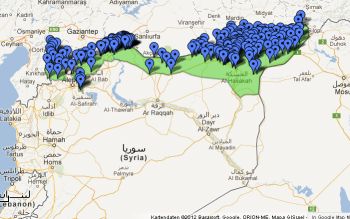
After many months of work and cooperation with many Kurds both inside and outside Syria, YASA, the Kurdish Center for Legal Studies & Consultancy, has created a map of Western Kurdistan.YASA Releases Syrian Kurdistan Map 'Western Kurdistan': First stage

_________

Syrian Kurdish fighters


War is bad -- except when it is fought by an oppressed people against a brutal oppressor. 

Then, whatever the cost, the human spirit sings at Heaven's gate.. . . .  While the joyous high lasts.

Friday, September 16, 2016

Blocking United States arms sale to Saudi Arabia


I am pleased to announce that Hawaii Senator Brian Schatz has joined  Senators Rand Paul, Chris Murphy, Al Franken, and Mike Lee to block the  $1.15 billion arms to Saudi Arabia.

I have a call in to Hawaii Senator Mazie Hirono's office to see if she has also co-sponsored the resolution.

The article below reports on significant House support for blocking the sale.

The article is authored by Rachel Stohl with theStimson Center,, previously unknown to me.  The Center has an impressive board of directors, including Hillary Clinton, soon to the President of the United States.

The analysis of reasons for and against the sale to Saudi Arabia , below, is well-reasoned.

Please call your senators to see if they have joined the bipartisan group against the sale.  A simple phone call will give you that information.  If you send what you find out, to me, I will publish it.


Block U.S. Arms Sales to Stop Indiscriminate Bombing in Yemen

By RACHEL STOHL and SHANNON DICKon September 16, 2016 at 4:01 AM


F-15s among weapons sold to Saudi Arabia
Last week, a bipartisan quarter of senators — Rand Paul, Chris Murphy, Al Franken, and Mike Lee — introduced a joint resolution to block the $1.15 billion sale of Abrams tanks and other major defense articles to Saudi Arabia in light of concerns about the kingdom’s actions in Yemen.

In the House, more than 60 representatives signed a letter by Rep. Ted Lieu to President Obama requesting a delay in U.S. arms sales to Riyadh. With opposition to arms sales to Saudi Arabia growing, the administration should use its leverage to encourage the Saudi government to cease its indiscriminate bombing campaign and delay future U.S. arms sales to Saudi Arabia until such change occurs.

The 18-month Saudi-led campaign in Yemen is believed to have resulted in over 3,800 civilian deaths and more than 6,700 injuries. US-manufactured weapons are being used to carry out the Saudi-led bombing campaign in Yemen, and strikes have hit civilian targets, destroying schools, markets, hospitals, and factories.

The United States is Saudi Arabia’s largest weapons supplier and it has provided logistical and intelligence support to the kingdom, along with billions of dollars in heavy conventional weapons. The Obama administration has prioritized Saudi Arabia’s special relationship with the United States and has requested a nominal $10,000 per year for International Military Education and Training (IMET) assistance so that Saudi Arabia can remain eligible for discounts on Foreign Military Sales. Since 2009 alone, the administration has authorized over $115 billion in sales of major conventional weapons to the Kingdom –including munitions, tanks, and fighter jets.

While proponents of continued sales to Saudi Arabia provide numerous justifications, many of those do not hold up. Indeed, the oft-heard refrain, “if we don’t sell, someone else will” is used repeatedly – but just because we can doesn’t mean we should. Complicity in contributing to human rights abuses and a massive humanitarian crisis is not in the U.S. interest, even if the U.S. could lose sales (itself a specious argument). If the Chinese or Russians want to sell weapons that they know will be used to kill civilians, let them. The United States holds an estimable position and a certain moral authority when it comes to the global arms trade – in both its robust (and restrictive) arms transfer control system and its attentiveness to potential risks – and should not negate its core principles when confronted with potential competition.

Congress rarely offers such a public critique of potential U.S. arms transfers, particularly to a close ally. The last time Congress successfully stopped an arms sale to Saudi Arabia was in the early 1990s, when fallout from the Gulf War led lawmakers to oppose a $20 billion arms package to the kingdom (the sale was eventually broken into smaller pieces; the transfer of some systems was postponed indefinitely).

The administration already has the tools it needs to encourage the Saudis to act. The use of U.S. weapons in Yemen runs counter to the laws and regulations that underpin U.S. arms transfers – such as the Arms Export Control Act and Foreign Assistance Act, Presidential Policy Directive 27, and its obligations as a signatory to the Arms Trade Treaty.

Congressional opposition shines a bright light on Riyadh’s conduct and increases pressure on the Obama administration not to accept “business-as-usual” for U.S. arms sales. The public display of disapproval takes important steps toward condemning and shaming the Saudi government’s behavior and encouraging a change to the air campaign.

Moreover, if given the choice, governments want to purchase U.S. weapons and systems, as they are better and more effective systems. It’s also possible that munitions manufactured by other countries may not work in U.S. systems – as they were not designed for interoperability. Saudi forces have historically relied upon U.S. systems and are not trained on systems from other countries.

Concerns that delayed U.S. weapons may impede Saudi Arabia’s ability to defend itself also fall short. The United States has sold billions of dollars in weapons to the Kingdom and has a long record of working with the Saudis to ensure security for the Kingdom and the region. That friendship and cooperation should not justify continued U.S. complicity in prosecuting a war that is harming civilians indiscriminately.

As President Obama and his advisors consider their legacy, it is time to stand up to those that violate human rights with impunity. Without a concerted and public effort to delay future sales, the United States effectively legitimizes the Saudi government’s actions. Ultimately, the administration will need to make a political decision to utilize its leverage to influence Saudi behavior and better adhere to its own values and principles.

Rachel Stohl is director and Shannon Dick is research associate of the Conventional Defense program at the Stimson Center.

Tuesday, March 29, 2016

Saudi Arabia and genocide in Yemen: the dead horse still has legs


Yemen's genocide is reported in many newspapers world-wide.  The United States loses respect, word-wide, as it continues to provide Saudi Arabia with cluster bombs and logistical support.
U.N. Condemns Airstrikes That Killed 106 in Yemen 

By NICK CUMMING-BRUCEMARCH 18, 2016 

The site of a Saudi-led coalition airstrike on a sewing workshop in Sana, Yemen, in February.CreditMohammed Huwais/Agence France-Presse — Getty Images


GENEVA — The top United Nations human rights official condemned the Saudi-led coalition [For information on the participants in the coalition see Members of Saudi-led coalition in Yemen their contributions Business Insider] fighting in Yemen on Friday, citing repeated attacks on civilian targets in airstrikes, including an attack on a crowded village market this week that killed 106 people. 

United Nations officials who went to the site of the attack on Tuesday in Hajjah Province found that airstrikes there had killed 106 people, including 24 children, making them the deadliest episode in the coalition’s yearlong intervention. 

The Saudis are backing the contested government of President Abdu Rabbu Mansour Hadi against rebels, known as the Houthis, who are aligned with former President Ali Abdullah Saleh. The Saudis have been pressuring the United States for support in the conflict, saying that their archrival, Iran, is backing the Houthis. [An odd and misleading statement.  See comments following 

this article.  For an article in Foreign Affairs Magazine opposing the Saudi clim that Ian backsthe Houthi, see  Iran not to hlame for Yemen] 

United Nations officials recorded the names of 96 people who died in the strikes, and they found 10 more bodies that were burned beyond recognition. An additional 40 people were wounded, “but that may be a low estimate,” said Rupert Colville, a spokesman for the high commissioner for human rights, Zeid Ra’ad al-Hussein. 

The Saudi-led coalition has repeatedly denied striking civilian targets during operations against Houthi rebels and affiliated forces. But United Nations officials said they had found no evidence of any military targets near the scene of the airstrikes, and Mr. al-Hussein said that may amount to a violation of international law.


Indiscriminate attacks by Houthi forces and their allies have also caused civilian casualties and could also qualify as international crimes, he said.

The coalition airstrikes came three weeks after its aircraft bombed another market, this time in a district of Sana, the capital, killing at least 39 civilians. The latest attack pushed the number of civilian casualties to close to 9,000, the United Nations said, with 3,218 killed and 5,778 injured. 

“It would seem that the coalition is responsible for twice as many civilian casualties as all other forces put together,” Mr. al-Hussein said, in a sharp rebuttal of the coalition’s denials. He was alluding not only to Houthis and the militias fighting with them but also to groups backing Al Qaeda and the Islamic State. 

The coalition has “hit markets, hospitals, clinics, schools, factories, wedding parties and hundreds of private residences in villages, towns and cities,” Mr. al-Hussein said, and it continues to do so “with unacceptable regularity.” 

At best, the coalition’s distinction between civilian and military targets was “woefully inadequate,” Mr. al-Hussein added, and “at worst we are possibly looking at the commission of international crimes by the coalition.”


 United States' and Great Britain's contribution to Yemen Genocide.

See Saudi Arabian-led intervention in Yemen Wikipedia, the free encyclopedia
The United States provided intelligence and logistical support, including search-and-rescue for downed coalition pilots.[7] It also accelerated the sale of weapons to coalition states.[93] US and Britain have deployed their military personnel in the command and control centre responsible for Saudi-led air strikes on Yemen, having access to lists of targets.[94][95][96]
The Saudi ambassador to the United Nations, Abdallah al-Mouallim is a businessman, not a professional ambassador. 

  
Watch as he struggles to defend the indefensible Saudi bombardment of Yemen:

What does Saudi Arabia want for Yemen and Syria?   - Al Jazeera English

Two of the many images of he bombing, on google images:


Images of the thousands of  Yemeni in the Yemen capitol, protesting the bombing, many holding up signs supporting Abudahah Saleh, the billionaire former president  of Yemen, now a principal financier of the Revolution.


Tuesday, March 15, 2016


The Foreign Affairs article, reprinted below,
  • praises Iran's public for electing "moderates" to its governing bodies; 
  • notes that the election goes a long way toward insuring the likelihood of success for President Obama's (and former Secretary of State Hilary Clinton's) Iranian Nuclear Deal, which congressional Republicans continue to try to frustrate;
  • notes that the European Union is lifting sanctions on Iran at a faster pace than the United States is, for reasons unspecified -- and the article notes the eagerness with which European businesses (and indeed businesses from China to Basil) are  doing striving for business with Iran;
  • argues  that the United States, alone of all nations, must retain the ability to impose biting sanctions on Iran;
  •  worries that the unequal lifting of sanctions may harm the United States' ability to impose biting sanctions on Iran;
  • and gives these reasons for maintaining a hard position toward  Iran:
[A]s Iran’s recent activities have shown, it is still a state supporter of terrorism, routinely abuses the human rights of its citizens, and is actively seeking to destabilize the Middle East. Aggressive enforcement of a robust sanctions regime will continue to allow the United States to pressure the country to abandon such activities.
Take the three points that make Iran different from countries that hold values different from the West's, in order presented:

1.  State Supporter of Terror  There is no internationally agreed definition of a terrorist; "terrorism" is in the eye of the beholder.

From the point of view of many Syrians, Salafi Jihadists funded by rich Saudi and the United Arab Emirates are terrorists.  From the point of view of Iranians, the United States is a terrorist state because it engineered the overthrow, by force, of a democratically elected president of Iran and installed an oppressive dictator  in his place.  Many Chileans and Argentinos would agree with Iranians on this, having suffered similar disruptions at the hands of the CIA.

Pakistan and India both got atomic bombs in violation of international protocols and neither is possible to be a rogue nation as Iran is.

The preference for one out of multiple standers on which to judge a nation's behavior,  picking the one uniquely designed to continue Iran's isolation, is not explained by the authors.  The preference is, however, a standard neoconic preference that appears frequently in neoconic writing.

2.  Routine Abuse of its Citizens.  The authors would do well to review  Foreign AffairsTime to get Tough on Saudi Arabia, which details the kingdoms historic and present human rights abuses on its own coins  The us does not escape unblemished:  many Iraqi condem the IranWar and the us treatment of prisoners in its prisons in Iranians in Afghanistan.  Many United States citizens deplore that the United States has more prisoners than any other nation.

Iran is deprives citizens who dress in  way its authorities think gay men might dress, of life.  Saudi Arabia whips them before and after it hangs hem.  The United States them them both beat on gay and women's rights issues.


3.  Actively Seeks to Destabilize the Middle East.  The authors again resort to double standards.

Saudi Arabia seeks to replace the elected, multi-ethnic government of Syria, brutal beyond belief, with a brutal Wahhabist one.  That the Saudi desire to have their own form of religion rule all of Syria is one of the main reasons no settlement of the conflict has been possible.

See


Are Iranians really worse for the United States than the Saudi?   Can we justify Saudi Arabia's genocide in Yemen?  If we punish one, shouldn't we punish both?  Shouldt we do our best to befriend the good in each?

And why are neocons so hard on Iran while turning a blind eye to failings in "friends?"  The United States has been punishing Iran for 7 decades because it had the the temerity to nationalize oil.

Time now to call a halt; take a hint from the European Union; relax sanctions; let Pakistan have as much natural gas from Ian's Pars Field as it wants; continue the move to join the community of nations.

SNAPSHOT March 1, 2016 IranSanctions


RAHEB HOMAVANDI / REUTERS
Iranians look at a list of candidates' names during elections for the parliament and Assembly of Experts, February 26, 2016.


Unfreezing Iran

And Doing It the Right Way


It makes sense that moderates’ recent electoral triumph in Iran—early results suggest that they have won a majority of seats in the parliament and in the Assembly of Experts—will improve the chances of success for the Iran nuclear deal. Iranian moderates, who generally back President Hassan Rouhani, were an important factor in concluding the deal and are likely to support its continued implementation.

As U.S. policymakers welcome the news that the Obama administration’s signal foreign policy achievement may be on sturdier ground, however, the continued successful implementation of the deal is having important and unanticipated consequences for the United States’ ability to use biting financial sanctions to achieve its foreign policy objectives.

In particular, the nature of the sanctions relief provided as part of the Iran nuclear agreement—which seems less likely to unravel after the election—may actually undermine U.S. sanctions in the future, in part by encouraging foreign companies to re-enter Iranian markets and decrease their reliance on the U.S. financial system. It is worth taking that risk into consideration as some policymakers cheer the outcome of the election and what it may mean for Iranian politics and the future of the nuclear agreement.

TARGET PRACTICE

Observers have focused on the role that economic sanctions played in bringing Iran to the negotiating table and ultimately signing the nuclear agreement. But the use of powerful financial sanctions has a longer history.

The United States introduced targeted measures after 9/11 to stem the flow of funding to terrorist groups. These were soon adapted for use against weapons proliferators such as North Koreaand Iran. The Treasury Department, building off the framework established in the early 2000s, continued sharpening these tools and—under significant pressure from Congress, which wanted to increase the coercive pressure on Iran—began to rely more heavily on so-called secondary sanctions, that is, prohibitions on non-U.S. businesses or individuals that continue doing business with a sanctioned entity. In other words, foreign firms were given a choice between dealing with rogue regimes such as Iran and having access to the U.S. financial system.

In recent years, sanctions far removed from the economy-wide prohibitions of the 1990s have targeted human rights abusers and leaders who violate the territorial integrity of their neighbors. Some of these sanctions include creative new restrictions, such as prohibitions on issuing new debt and equity for certain targeted financial institutions and limits on cooperation for developing energy resources.

Policymakers have recognized the potential for such new sanctions to combat unconventional challenges as well. For example, U.S. President Barack Obama recently granted the secretary of the treasury the authority to impose economic sanctions on foreign countries and companies that engage in malicious cyber activity, namely launching cyberattacks on critical infrastructure or stealing commercially valuable information. Likewise, the United States has developed sanctions that target corruption in countries such as Venezuela andBelarus. In short, coercive economic measures have become the tool du jour. Today, U.S. officials are bullish about using more sophisticated and targeted sanctions when diplomacy alone is insufficient but force is not a feasible option.

UNSANCTIONED

Yet, as policymakers have become enamored with these tools, they have paid much less attention to how they can be unwound effectively—and what the specifics of the unwinding will mean for the United States’ ability to successfully use sanctions in the future. The implications are easy to see in the case of the sanctions relief provided to Iran on implementation day.

Whereas the EU and other states have largely relaxed their Iran sanctions programs, the United States has only discarded some of its restrictions. The different paces at which the United States and EU are unwinding their sanctions programs pushes European and Asian companies to avoid conducting transactions in U.S. dollars and in U.S. markets and so could diminish the United States’ ability to impose biting financial sanctions in the future.

Following implementation day, most EU sanctions and U.S. secondary sanctions—which applied to non-U.S. entities—were removed. European companies interested in doing business in Iran’s financial and banking industry (and its energy sector) are no longer prohibited from engaging in a wide range of activities. At the same time, extensive prohibitions remain on U.S. companies and individuals thinking about doing business in Iran, and European companies cannot use the American financial system for Iran-related transactions without running afoul of those sanctions.

The inability to access the U.S. financial system is a major impediment to foreign firms wishing to do business in Iran: transactions in U.S. dollars have long been the norm in most international markets and sectors, accounting for approximately 85 percent of global trade transactions, even when the parties involved are based outside the United States. By prohibiting firms from relying on the dollar to do business in Iran, the United States is giving those companies incentive to conduct transactions in other currencies, with potentially significant consequences for the preeminence of the U.S. financial system and the United States’ ability to impose financial sanctions.

For example, the State Bank of Pakistan has been asked by the Government of Pakistan to draw up an “interim credible payment mechanism” so that Pakistani businesses can enter Iran without worrying about dollars. South Korea is looking to encourage dealings with Iran in its own currency or else euros. Further, the Bank of Tokyo-Mitsubishi recently announced that it wouldhandle payments by Japanese oil refiners to Iran in both yen and euros. Likewise, two other Japanese banks are reportedly looking to restart non-dollar wiring services to Iran as well. And Brazil’s trade minister recently announced that his government will look to enable payments in euros and other currencies to and from Iran because “everyone is racing after Iran now…the trade potential is very big.”

In short, governments and private actors around the world are experimenting with avoiding the dollar because of an unbalanced unwinding of the Iran sanctions.

These moves only continue a recent, larger trend of companies and countries avoiding the U.S. financial system. In the past few years, countries worried about being targeted by U.S. sanctions have begun developing alternative currency and payment systems. For example, many analysts believe that the recent Chinese push to make the renminbi a reserve currency was partly the result of a Chinese desire to ensure that the United States would not be able to bring significant coercive economic leverage to bear on China in the future. Similarly, China’s establishment of the China International Payment System (CHIPS)—a system designed to mimic SWIFT, which is an entity that helps coordinate the transfer of trillions of dollars in financial messages every day, and facilitate the processing of renminbi transactions—could insulate the country from the sanctions that proved so powerful against Iran.

The trend may also threaten U.S. economic competitiveness over the longer term. To the extent that international companies actively avoid the U.S. financial system, U.S. markets will no longer benefit from their business. While the extent of such potential damage is unclear, senior Treasury Department officials have expressed concern about these consequences.

And now, by giving foreign companies even more reason to use alternative currencies and financial markets the United States threatens to accelerate this trend. And that, in turn, could undercut the country’s ability to impose powerful financial sanctions in the future, since the United States often relies on the use of the dollar in cross-border transactions to create the jurisdictional hook necessary to impose biting sanctions. Without that hook, the United States will be less able to penalize companies that conduct business with rogue nations or terror groups.

FUTURE SANCTIONS

This is not to say that the United States should remove all of its sanctions on Iran just to match Europe. The United States has maintained those restrictions for good reason: as Iran’s recent activities have shown, it is still a state supporter of terrorism, routinely abuses the human rights of its citizens, and is actively seeking to destabilize the Middle East. Aggressive enforcement of a robust sanctions regime will continue to allow the United States to pressure the country to abandon such activities.

Policymakers and regulators tasked with protecting the U.S. financial system from exposure to illicit activity know that financial crimes, including bribery, other corruption, and money laundering, remain pervasive in the Islamic Republic. Iran ranked 130 of 167 countries in Transparency International’s 2015 Corruption Perceptions Index. U.S. officials know that allowing Iranian business to be conducted through the U.S. banking system might enable more such crimes.

But at the very least, policymakers need to recognize that they face a difficult choice. In their attempts to unwind certain sanctions on Iran while maintaining some economic pressure on the country, they may be hurting their ability to employ financial sanctions against Iran or other targets in the future. Given that policymakers have increasingly turned to these economic tools in recent years, they should understand the tradeoff and develop ways to maintain the United States’ ability to impose biting financial measures. Only then will it be able to preserve these powerful tools into the foreseeable future.