Wednesday, March 14, 2012

The U.S. Naval Academy's answer to Turkish Oil Wrestling

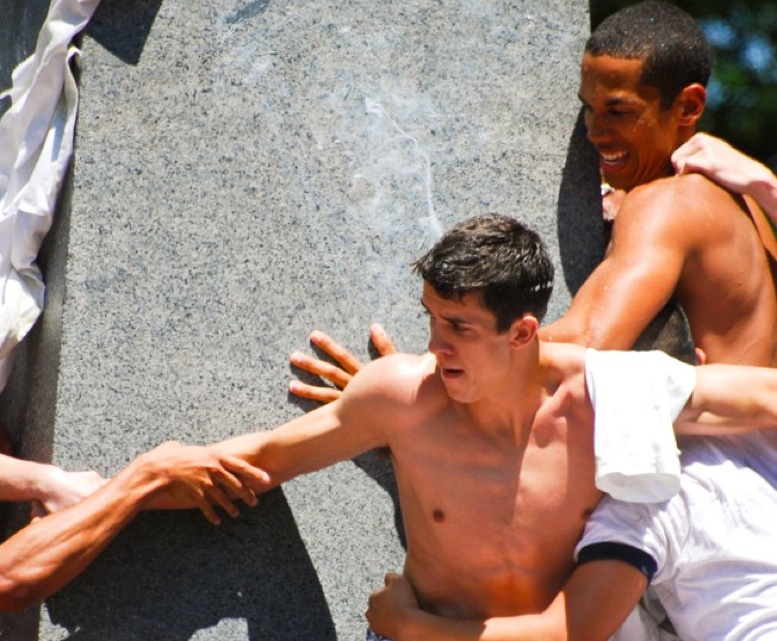
Every May, the U. S. Naval Academy's freshmen race to see how fast one of them can reach the top of a the liberally-greased Herndon Monument, located on the Academy grounds.

The Academy scholars are, of course, being trained to be killers.  But they're young;  many of them seem like puppy dogs;  and some like angels.

Here's samples:


Monday, March 12, 2012

The Manly Sports of the Turkic Nations: Kirkpinar -- Turkish Oil Wrestling

In 2009, four Turkic-speaking nations established the Turkic Council.  The four are Turkey, Azerbaijan, Kazakhstan, and  Kyrgyzstan.  Two others,  Turkmenistan and Uzbekistan, are expected to join soon.

Areas in which the Turkic language is spoken.

The turkic Council covers a large part of Central Asia.  
 (Prospective council members in blue)

Turkic people have a long history and many things in common.  One of the things they have in common is hand-to-hand sporting competitions, usually shirtless. 

You've seen my 2010 Turkish Oil Wrestling.  Below are some more images from 2011 and before, as a trailer for July, 2012, when the next national competition will be held.  To come in future posts are naional sports of  Azerbaijan, Kazakhstan, and  Kyrgyzstan.  Pretty interesting.  Maybe, too, of Turkmenistan and Uzbekistan, if I can find some good ones.

Oil Wrestling ( Kirkpinar) from Turkey, 2011 and earlier.


North American equivalent?


Monday, March 5, 2012

South Yemen, Independent or a Federated State?

If a Yemeni wants to send me a comment on this article I'd appreciate it.  I'm an old man living on a small island in the middle of the Pacific Ocean, a long way from the troubles and strife and joys of people in South Yemen.  I'm emotionally in favor of Southern Independence.  I can understand the urge for  federal resolution, and wouldn't trust Saleh's successors to honor any agreement.  I think my country, theUnited Staes, should support the people of the South in determining their own course.  Tell me if I'm wrong.

Durell Douthit
ddouthit@mac.com


As Yemen strives to move on, the South fights for independence


Protesters in the southern port city of Aden wave a flag from the former People’s Democratic Republic of Yemen and carry a portrait of  separatist Ahmed Darwish, a political prisoner who died in detention.
 
As Yemen’s new President Abd-Rabbu Mansour Hadi toils to rein his country back in from the brink of civil war by calling on its people to “build a new Yemen”, separatists in the South have turned a deaf ear, staging protests to demand they be allowed to secede from the North. According to our Observers, the South’s relentless drive for independence has in part punctured the ballooning hope that Yemen might finally have the chance to move past its turbulent past, after 33 years of autocratic rule under former President Ali Abdullah Saleh.
 
Supporters of the South’s separatist movement staged a march on February 29 in the port city of Aden, where protesters peacefully brandished flags from the former People’s Democratic Republic of Yemen, a once autonomous state before reunification with the North in 1990. The demonstration was held in solidarity with a separatist camp in Aden’s Mansoura neighbourhood, which was brutally dismantled by the Yemeni army just days before. The operation to break up the camp lasted several hours and was punctuated by the bang of weapons fire, which left one person dead and three others injured.
 
Separatist demonstration in Aden on February 29.
 
A little more than a week before, Yemen’s presidential elections were marred by violence after members of the country’s Southern separatist movement attacked a number of polling stations in Aden, forcing several to close. The vote was highly criticised due to the fact that Saleh’s vice president, Hadi, was the sole candidate featured on the ballot.
 
Tensions between the North and South have run high since reunification, boiling over into civil war in 1994. Although the North ultimately emerged as the victor, Yemen continues to be marked by internal strife and periodic violence. The South Yemen Movement, a civilian separatist group, was founded in 2007 with the goal of advancing the fight for independence through non-violent means.

“Some separatists thought that Saleh’s downfall would immediately result in the South’s independence”

Shafii Al’abd is a member of the South Yemen Movement.
 
The separatist movement that took hold in the region splintered during the popular uprising. One faction was drawn to the protest movement, adopting the exact same anti-government slogans used by Yemenis in the North. They held former President Ali Abdullah Saleh responsible for the civil war between the North and South in 1994. There were also some who also thought that Saleh’s downfall would immediately result in the South’s independence. But not all of the country’s young revolutionaries support the idea of an independent south. To the contrary, the majority are against secession and stick to rhetoric on ‘reform’.
 
The other faction, which is larger and more radical, continued to demand their independence outside of Yemen’s popular uprising. Their refusal to join the anti-government protests was symptomatic of their abhorrence of anything connected with the North.
 
Personally, I’m not necessarily for the idea of seceding, but I do think that people in the South have the right to self-determination. Last November, the movement’s most moderate party, which I belong to, met in Cairo to address the issue. We put forth that the conditions of reunification in 1990 be re-examined, and called for the formation of a federal state. At the end of five years, people in the South should be presented with a referendum on whether they are happy with their new status.
 
To build support for these objectives, we’ve focused on mobilising youth who participated in anti-government protests [many of whom have refused to support political parties who joined the country’s Joint Meeting Party, an umbrella opposition group, and continue to stage anti-government protests], who are sympathetic to our cause, because we won’t be able to achieve our goals under Saleh’s system, which is still in place".

“The separatist movement does not represent those who live in the South

Mugahed is studying to become a pharmacist at the University of Aden.
 
The South was where Yemen’s anti-government protest movement really kicked off. You have to remember that the first victim of the uprising against Saleh was in Aden. I was at the very first demonstration and I can tell you that there wasn’t a single flag representing the People’s Democratic Republic of Yemen [pre-reunification South Yemen]. Of course there were separatists at the protests, but they’re demands were the same as those of the anti-government protesters – liberty, equality, justice… Six months later, leaders of Yemen’s Southern movement said that the protests were going nowhere, and abandoned the cause to resume calling for independence.
 
Many in the South didn’t appreciate this sudden shift in attitude, and interpreted as a lack of direction. Not only have they distanced themselves from the support base here in Yemen, they are also financed by Yemenis living abroad - for example, in other Gulf countries, or in Britain or the United States. Even the owner of the separatist television station, Aden Live TV, is funded by expatriates. It leaves you with the impression that the movement is completely disconnected from the reality on the ground.
 
I think that the leaders of the separatist movement are not representative of those who live in the South. It’s true that there are still people who are protesting for independence, but it’s their way of making sure that their voices are heard in the North. They’ve put their demands very high to make sure that they get something in the end. But when you speak with these people, they have no real, concrete political or economic ideas of what they’re going to do in the event that the region does gain independence.
 
What’s more, Sanaa has recently named a new police chief and security chief in Aden who have shown a desire for change that many locals support. And, you can’t forget that Mansour Hadi is originally from the South, even if he is part of the system. Since his election, it’s no longer fair for opposition leaders to say that the South is not represented in government.
 
There are certain towns in the South that are determined to fight for their independence, partly because they haven’t been able to forget the violence between the Syrian army and the separatist movement, in particular during 2007 [the year when the South Yemen Movement was founded]. There were also a number of military leaders who were ousted from power over their role in the civil war against the North in 1994. But I think that the majority of people in the South, especially in Aden, support the idea of redefining the terms of reunification to make it fairer rather than seceding from the North as a whole”.

Monday, February 20, 2012

Chewing qat, defecting to South Yemen

This is my favorite symbol of the Southern Secessionist Movement in Yemen and a totem picture of mine:  young secessionists sitting under a graffiti of the South Yemen flag, chewing qat.


Lebanon’s Daily Star today kindly sent me two more images, showing Yemeni soldiers defecting to the South, in similar poses, chewing qat.  

Would it be a better world if all the world chewed qat?  

We wouldn’t get much done, and Aldous Huxley correctly pointed out that those who do nothing at least do no harm: a message that 20th Century million-killers -- doers, one and all -- and those they burned, maimed, twisted on racks ’til sinews gave way, split all ends up, buried alive, did all manner of evil to,  

could have profited from.


And se


For Dylan Thomas, And Death Shall Have do Dominion
from which fragments are taken. . .

Tuesday, January 31, 2012

The Swoon, then and now

Now I ask you, which is designed to appeal more to the prurient interest. . .

Caravaggio,
 St. Francis of Assisi in Ecstasy, 1590


A photograph from the excellent blog, bootlust,
entitled, inexplicably,
Eat that ticket 2012

Saturday, January 14, 2012

Poster Boy for the 21atCentury


It's not as bad as being shot dead by Syrian President Assad's "security" forces


or being in a crowd facing indiscriminate rifle fire


It's not as brave as South Yemeni standing up to live fire


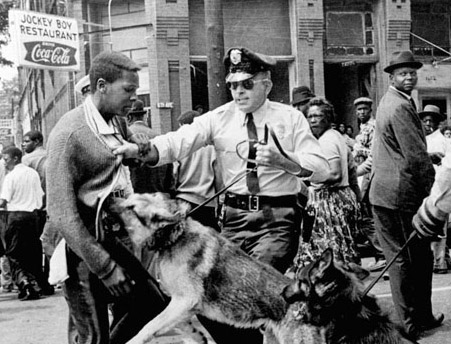
It's not as brutal as Bull Connor in Birmingham in 1962, sicking police dogs on peaceful protesters


or Richard Nixon's military at Kent State:  four dead and dead forever


It's not as bad as being hanged by our country's friend, the King of the Saudis, for no more than being such as I and perhaps such you as you. . . .


But it's bad enough, and a harbinger.

From the Constitution of he United States of America:

Congress shall make no law   bridging . . . the right of the people peaceably to assemble, and to petition the Government for a redress of grievances.

What could be a more peaceable assembly than one sitting quietly?

On November 19, 2011, folks at a greet State University, the University of California at Davis , were sitting quietly, to petition for redress of grievances; and this happened:


• • • • • • • • • •          • • • • • • • • • •

TimeWorld has an illuminating article on nonlethal methods used by them with the power to use 'em, to secure obedience to their wishes, whether their wishes be lawful or not.  

It is the nature of persons in authority to be displeased by those who disobey them.  "Nonlethal methods" is the modern way asserting that displeasure. "Democracies do not kill" intoned the Indian government after it killed protestors after the Mumbai riots; and the government instituted a series of "nonlethal methods" to be used instead; institutionalized their use.

If  one follows the Rule of Law -- the one thing that distinguishes us from dictatorships -- one who is thought to have violated a law is arrested, brought before a judge and a jury, tried fairly, and if but only if convicted, sentenced to a lawful punishment.

Nonlethal methods of crowd control dispense with all that falderal.  You are instantly punished, with no process at all, and more often than admitted, the punishment is death.

The Times article observes

The history of what is euphemistically called nonlethal pacification stretches back more than a century. The first official iteration was the Victorian policeman's truncheon, a heavy stick used to smack miscreants upside the head.

Read more: http://www.time.com/time/world/article/0,8599,2009006,00.html#ixzz1jUodyCPe
We are now at the merest gentle beginning of the World to Come.    We now have tear gas (illegal at war but not in suburban Aina Haina), pepper spray, he horrible Taser, the water Canon (Where is Tom Lehrer, now that we really need him), and the army has developed a form of long-range microwave oven than can bake your skin at 700 feet if you are not obedient enough, nor obey quickly enough.  We are of course, not privy to other devices our representative Democracy has developed, nor that it's adversaries around the world are developing.

Well, we in this Country like to protest and like to do it with vigor; and we don't like to be told what to do by popinjays in blue suits.  Perhaps, in time, we'll get fed up and insist that we really, truly do have the right peaceably to assemble, to speak freely, to worship or not as we please, and not even mighty Google will be able to hinder us.

But if w don't, I give you 

The Poster Boy for the 21st Century!


• • • • • • • • • •          • • • • • • • • • •


The New York Times today would have us look at the One Percenters not as a monolith but as a varied collection of individuals, some of whom are presented sympathetically and none as Malefactors of Great Wealth.  One striking point:  the One Percenters were not adversely affected by the Recession.  The Times article fits with the few wealthy folks I met in my law practice.

The "handmaidens of the wealthy", namely cops of all descriptions,are not monolithic, either,   One example from my practice, which I could multiply many times:  A cop said, in my office, with glee: " I put a druggie 's head through a fish bowl jut now."  A few moments he was in anguish because his wife wouldn't let him see his children, whom he love as much as he loved life.

When we see foes as discrete individuals and not as monoliths, organizing against them becomes hard.  And the necessity of opposing them, with their new techniques of humiliation, is self-evident.

Sigh.

• • • • • • • • • •          • • • • • • • • • •

Someday it will be necessary to deal with the "legal pacification" of populations in Germany, Russia, China, Cambodia, and many other places, in the murderous 20th Century.  Pray, if you find there point in it, that the 21t doesn't give us different but equivalent horrors.  That's why I call Davis pepper spray a harbinger.

• • • • • • • • • •          • • • • • • • • • •

We may no longer have Tom Lehrer, but we have artists with wit and imagination.  Some have had a field day with our Poster Boy.  If you would like o see some of their work,